by Johnny Cycles, January 16th, 2026

Hello! Welcome to another edition of Keeping Modern Janky! It’s the final article before Lorwyn Eclipsed releases and I’m testing out a card I didn’t originally have on my radar. That, and I think people aren’t too interested in an Affinity deck whose only claim to jank is Sokka, Bold Boomeranger… I had him in my #2 spot of top 10 Modern cards from Avatar: The Last Airbender. Alas, even I didn’t get around to playing him.
Speaking of top 10s…Be sure to check out my top 10 Modern cards for Lorwyn Eclipsed!
The origin of this deck can be found in my love of flash creatures. Ephara, God of the Polis is one of my favorite Commander decks. It combines my love of creatures and my secret love of Control-style strategies…shh, don’t tell my Dragons.
Aang, Swift Savior continues a line of 3-mana creatures that more or less all do the same thing: counter a spell with a slight catch. The first one of these in my memory is Spell Queller, though there may be others before it (Venser, Shaper Savant costs , but can be seen as the predecessor of these powered-up versions).
I say counter a spell with a catch because none of these cards are strictly Counterspells.
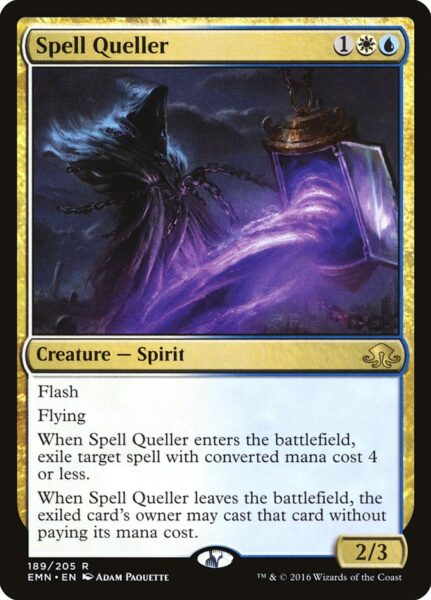
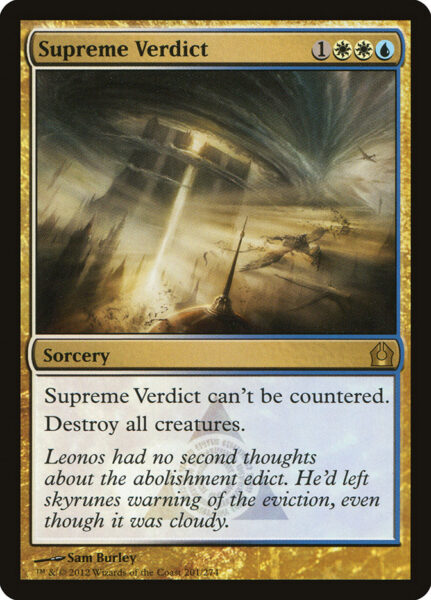
Spell Queller don’t care if it can’t be countered.
First, the limitations. The spell’s controller can recast that spell for a cost, whether it be by killing Spell Queller, or paying extra mana, or waiting a turn. Thus, the spell we counter isn’t gone forever.
Now for the benefits. Since these cards exile the spell they target, they get around all Control players’ most hated line of text: “can’t be countered.”
But what if there was a way to turn these exile effects into true Counterspells?

Enter Drannith Magistrate.
Anyone who plays Commander knows about this Human Wizard since he prevents you from casting your commander from the Command Zone. This alone has made him a game changer.
Now what if we pair him up with the likes of Aang, Swift Savior, Spell Queller, and other annoying ways of exiling our opponent’s cards? Can a deck like this compete in Modern?
Decklist – Azorius Aang
by Johnny Cycles
Format: Modern
Creatures (31)
Spells (7)
| 4 Counterspell | |
| 3 Avatar’s Wrath |
Lands (23) (+1 mfdc)
| 1 Eiganjo, Seat of the Empire | |
| 4 Field of Ruin | |
| 4 Flooded Strand | |
| 1 Floodfarm Verge | |
| 2 Hallowed Fountain | |
| 3 Island | |
| 2 Meticulous Archive | |
| 1 Otawara, Soaring City | |
| 4 Plains | |
| 1 Witch-Blessed Meadow (mfdc) |
Sideboard (15)
| 4 Consign to Memory | |
| 3 Rest in Peace | |
| 4 Voice of Victory | |
| 1 White Orchid Phantom | |
| 3 Force of Negation |
Deck Tech

Primary Game Plan
Our main goal is to exile all of our opponent’s spells and/or permanents, then prevent them from ever recasting them with a timely Drannith Magistrate. At this point, we can hold up our flash creatures for whatever removal spell our opponent finds and beat face with our fliers.
Which is the answer to the question you may be asking yourself now. Why bother with conditional counters when we could just play real counter magic? Other than Azorius Control running contrary to the theme of this entire column, our pseudo-Counterspells all come with an evasive body. Anyone who is familiar with the Snapcaster Mage beats of several years ago know this 2/1 was/is considered a real finisher in Control decks. Our versions of Snapcaster Mage all have flying!
This will hopefully allow us to close out the game before our opponent can recast their spells, should we not have a Drannith Magistrate out.
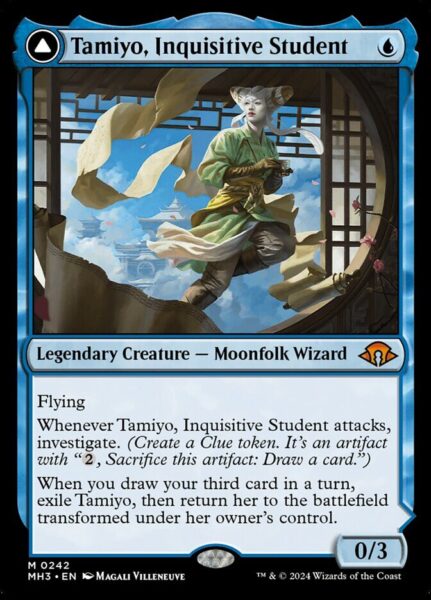
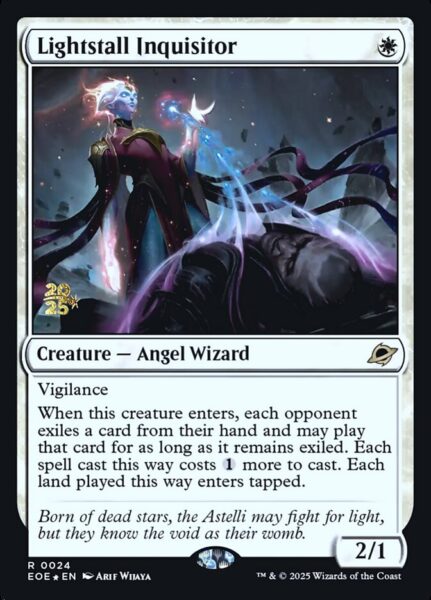
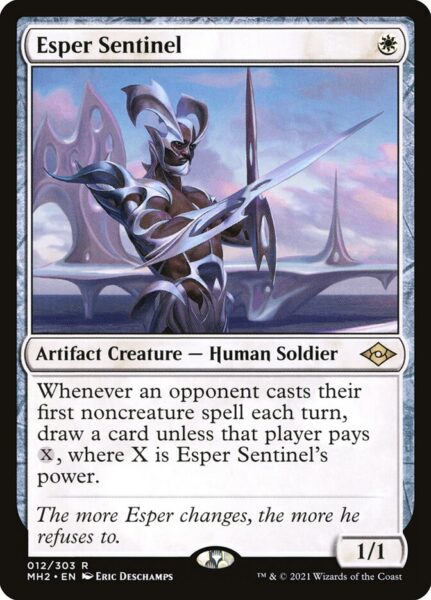
Our early game all synergizes with our primary game plan. Tamiyo, Inquisitive Student and Esper Sentinel both give us some early conditional card draw to help dig for our pieces. Both will often draw out a kill spell, which can help clear the way for Drannith Magistrate to live.
Note: I’ve cut Esper Sentinel for four copies of Counterspell in the final version of the deck. I’m including it here since it appears in some of my matches and because it is another powerful means of taxing our opponent. It may be right to include it.
Lightstall Inquisitor can slow our opponent down early or get rid of a card permanently as long as Drannith Magistrate is out. The 2/1 vigilant body isn’t bad, either.
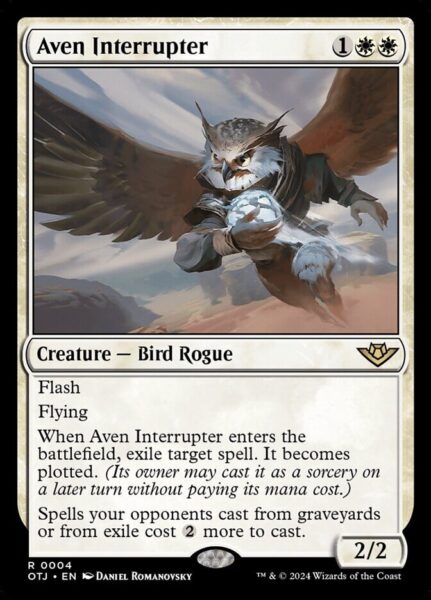
The 3-drop spot is where the fun really begins. In some ways, Spell Queller is the least effective Counterspell, while Aven Interrupter is the most effective. I currently play 4 copies of each, which can lead to some awkward starts where we have nothing to do in our opening turns. It’s possible we should cut one copy of each to make room for either Esper Sentinel or some other 1-mana interaction.
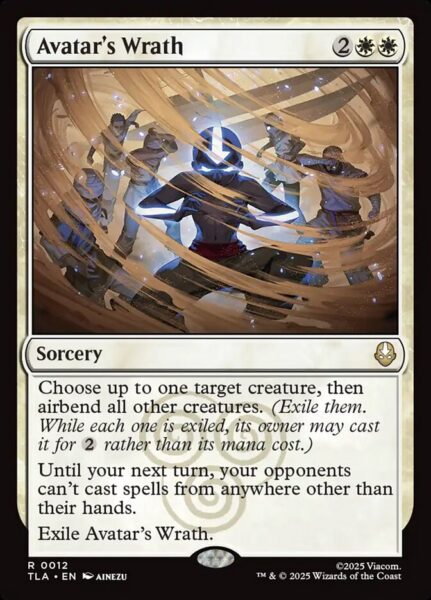
Avatar’s Wrath is our catch-up card. The way the deck plays, we will often be somewhat behind on board, as so much of our interaction is three mana. Sure, we will sometimes be able to counter something with Counterspell on turn 2, untap and play a land, then pass with three mana to flash down one of our creatures. Just as often, though, we’ll watch our 1 drops get killed or outclassed by our opponent’s creatures, leaving us not interacting with our opponent’s growing board until turn 3, which will often be too late.
Regardless of how the early turns go, Avatar’s Wrath is meant to let us reset the board, while ideally preventing our opponent from recasting any of their creatures we exile thanks to Drannith Magistrate. The dream is to target Drannith Magistrate with Avatar’s Wrath, then wipe away the rest of the board.
Of course, as I learned the hard way, and as you can watch here, once you choose a creature with Avatar’s Wrath, its resolution depends on that creature not dying. Thus, if our opponent responds by killing the creature we target, the whole spell fizzles.
If we’re worried about spot removal, we’ll have to exile all creatures, then recast the Magistrate on our next turn. And honestly, unless we have the mana to counter something after casting Avatar’s Wrath, this is probably the correct move anyway.
One of the best things about the above scenario is that all of our 3 drops that get exiled with Avatar’s Wrath will then function as pseudo Counterspells that cost . At this point, we are hoping that our opponent can’t win the game or flood the board with what’s in their hand until we can untap and have access to all of those sweet enters effects once again.

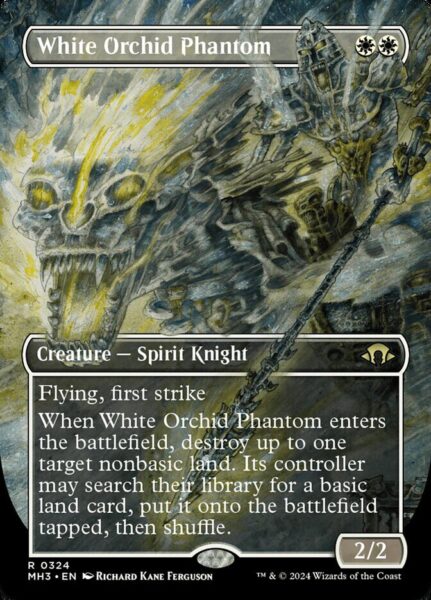
Wan Shi Tong, Librarian and White Orchid Phantom round out our creature package. Honestly, the main reason Wan Shi Tong, Librarian is in the deck is simply that I really like it and want to play it. I do think it fits very nicely in our deck, given that it has flash, we need more card draw, and it gives us another good finisher. However, given that we are sort of a Combo deck, it may be correct to cut it in favor of something like Preordain.
White Orchid Phantom gives us some maindeck hate against the big mana decks out there. Its evasion is very relevant, as well. And, since it has an enters effect, we can recast it after we exile it with Avatar’s Wrath to get more value out of it.
Sideboard
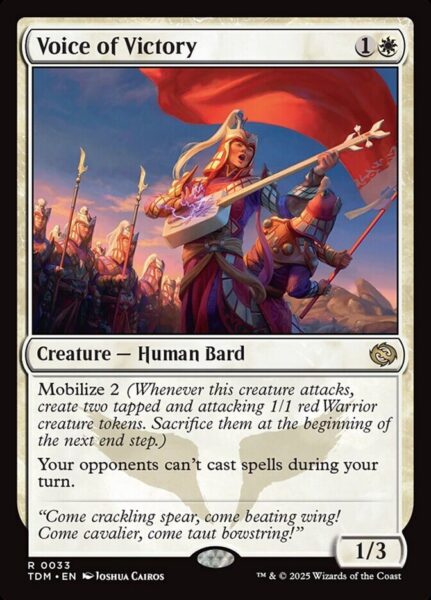
Nothing too spicy here, other than Voice of Victory. I like this card as a way to bring in more pressure against other Control decks, and all of those decks running lots of spot removal.
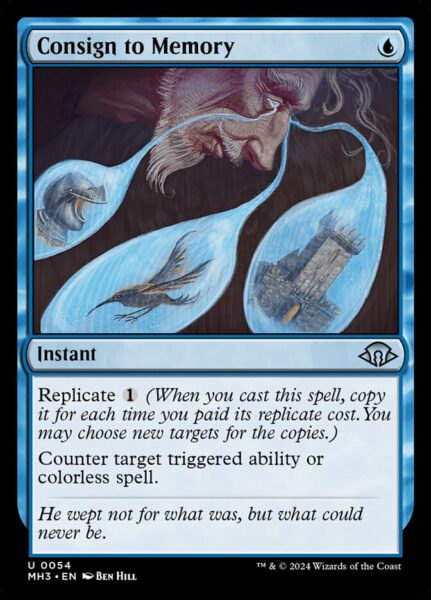
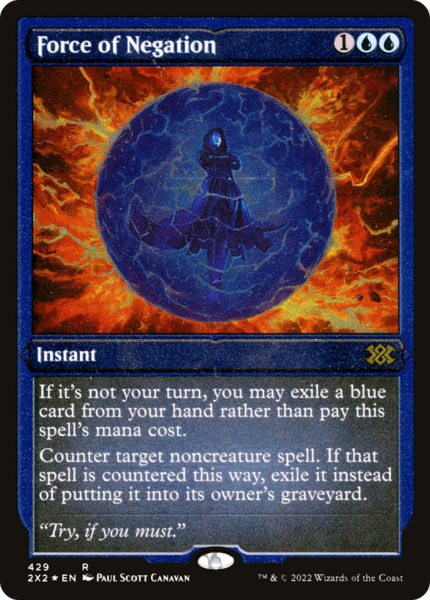
I finally forked out the money for the playset of Consign to Memory, which I’m hoping will pay for itself. Three copies of Force of Negation give us a way to fight the unfair decks, protect a Drannith Magistrate, or win a counter battle. The fourth copy of White Orchid Phantom could be something else and I may change it once I test the deck more.
I’m trying something new and posting all of the games in a single video. Let me know if you prefer this over each individual video being posted!
Full Game Play
Overall Record: 3-4
Not bad, though I was hoping for better. The deck was a ton of fun to play and it feels very competitive. The chief problem for us is that we don’t have a very fast clock. This means our opponents have a ton of time to draw what they need or to cast what we’ve exiled, assuming we don’t have a Drannith Magistrate out. I have the full playset of Voice of Victory in the sideboard to help ameliorate this, but it’s possible we should make room for it in the 60. Wan Shi Tong, Librarian, for example, is a flex spot, as is White Orchid Phantom. I’d cut the former, rather than the latter.
Still, since we’re essentially a Control deck with a Combo lock, we have game against just about every deck we play. Our maindeck wraths can help against Aggro, while our various Counterspells on sticks can deal with most everything else. The big drawback of these, besides their obvious limitations, is that they cost 3 mana. Sometimes we are just too far behind by the time these come online.
For instance, in our Dimir match-up, our opponent had just a little bit of pressure before we got to 3 mana and was still able to sit back, draw cards off of their Tamiyo, and wait until we did something.
With this in mind, I built a second version of this deck at the same time I built this one. It’s Bant Aang and can ramp into a turn 2 Aang, Swift Savior or Spell Queller. I had hoped to play a few matches with it to show you here, but I ran out of time. I’ll save it for another day.
In the sideboard, I cut the fourth copy of White Orchid Phantom for a fourth copy of Rest in Peace. I also cut two Field of Ruins from the deck.
Conclusion
While we didn’t get to hose people with the above combo as much as I’d have liked, we did see it in action a few times. Domain Zoo and Grixis Reanimator, for instance, showed the synergy, power, and fun of exiling our opponent’s things and not letting them recast them. But even without getting this online that much, the deck was a lot of fun to play! I love my U/W Flash deck in Commander and this deck plays similarly. So if you’re looking for a bit of a janky, creature-based Control strategy, or just have an unhealthy obsession with Drannith Magistrate and that silver fox beard, give this deck a chance!
As always, thanks for reading and watching! Let me know in the comments what you think!