by Johnny Cycles, Thursday, August 27th, 2026
Be sure to subscribe to my YouTube channel to support my content and see the videos before they make it to this site!
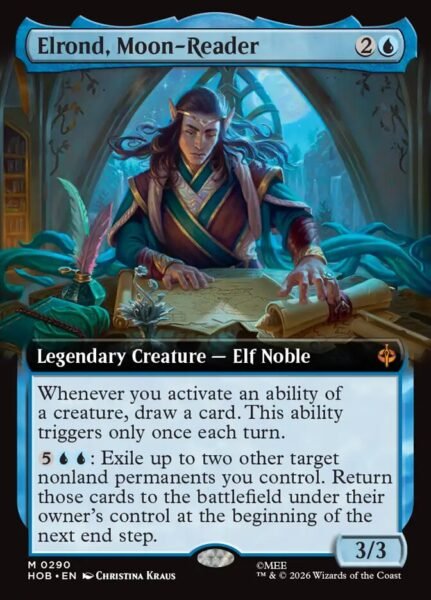
Elrond, Moon-Reader from The Hobbit is a new legendary creature that cares about two things we don’t often see together on creatures: an enters ability alongside an activated ability. In fact, 0f the 17,750 creatures in Magic, less than 600 of them have both. Of these, under 100 are Blue. Can we build a viable, fun deck around these few creatures, or should we take a different route?
Here’s what I came up with:
Decklist – Activate Card Draw!
| Elrond, Moon-Reader |
Creatures (36) – Total Cost: $66.30
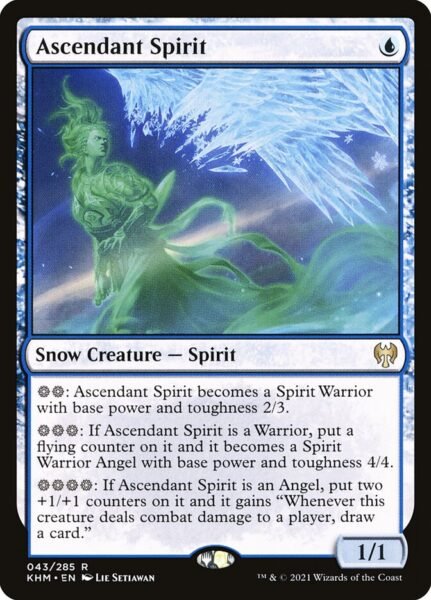
| Ascendant Spirit | .38 cents |
| Harmonized Trio | .77 cents |
| Rishadan Dockhand | .33 cents |
| Dour Port-Mage | $2.52 |
| Faerie Vandal | .25 cents |
| Hangarback Walker | .35 cents |
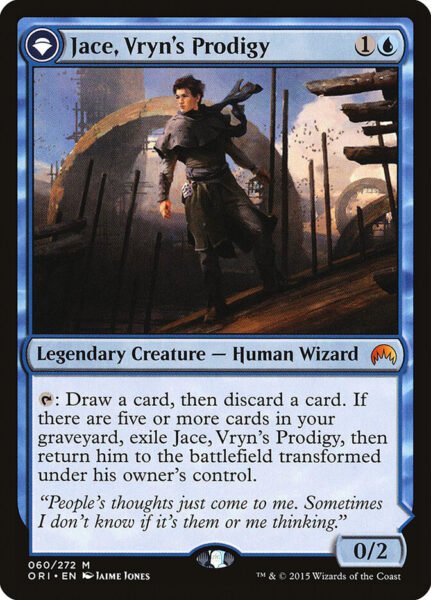
| Jace, Vryn’s Prodigy | $5.06 |
| Jacob Hauken, Inspector | .55 cents |
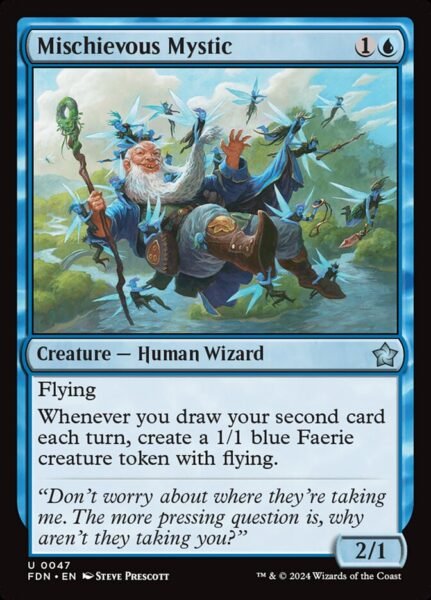
| Mischievous Mystic | .30 cents |
| Mindshrieker | .59 cents |
| Patchwork Crawler | .30 cents |
| Spellskite | $7.61 |
| Triskaidekaphile | .65 cents |
| Troop of Ponies | .32 cents |
| Chasm Skulker | .40 cents |
| Detective of the Month | .40 cents |
| Ioreth of the Healing House | .35 cents |
| Jill, Shiva’s Dominant | .46 cents |
| Kefnet the Mindful | .40 cents |
| Laboratory Maniac | .42 cents |
| Minn, Wily Illusionist | $8.72 |
| Nadir Kraken | .35 cents |
| Shorecrasher Elemental | .50 cents |
| Thassa, God of the Sea | $3.63 |
| Tishana’s Tidebinder | $2.28 |
| Volo, Itinerant Scholar | .50 cents |
| Alandra, Sky Dreamer | $9.16 |
| Ethereal Investigator | .43 cents |
| Homunculus Horde | .97 cents |
| Master of Waves | .40 cents |
| Oneirophage | .25 cents |
| Paragon of Gathering Mists | .25 cents |
| Toothy, Imaginary Friend | $10 |
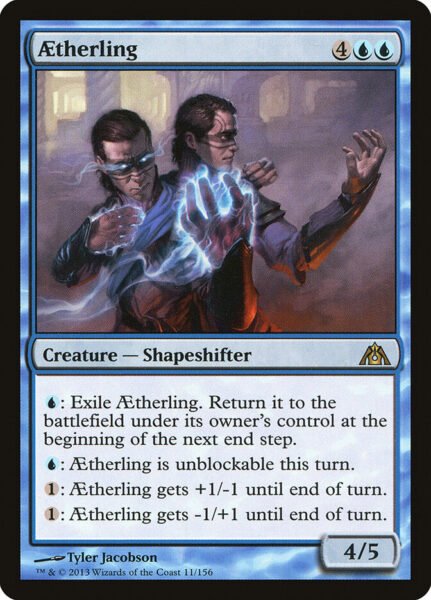
| Aetherling | .37 cents |
| Deadeye Navigator | $3.03 |
| Agent of Treachery | $3.15 |
Artifacts (4) – Total Cost: $4.20
| Wayfarer’s Bauble | .36 cents |
| Arcane Signet | .48 cents |
| Thought Vessel | $2.87 |
| Kefnet’s Monument | .49 cents |
Enchantments (6) – Total Cost: $14.43
| Honest Work | .27 cents |
| Training Grounds | $9.11 |
| Witness Protection | .25 cents |
| Wizard Class | $2.62 |
| Eaten by Piranhas | .37 cents |
| Sphinx’s Tutelage | $1.81 |
Instants (12) – Total Cost: $11.39
| Consider | .30 cents |
| Magic Damper | .27 cents |
| Octopus Form | .25 cents |
| Opt | .25 cents |
| Pongify | $2.17 |
| Rapid Hybridization | $1 |
| Shore Up | .27 cents |
| Consult the Star Charts | $3.08 |
| Counterspell | $1.45 |
| Think Twice | .20 cents |
| Archmage’s Charm | $1.65 |
| Disallow | .50 cents |
Sorceries (3) – Total Cost: $2.37
| Boomerang Basics | .95 cents |
| Preordain | .67 cents |
| Serum Visions | .75 cents |
Lands (38) – .97 cents
Field of Ruin .30 cents
Myriad Landscape .30 cents
Reliquary Tower .37 cents
Snow-Covered Island (34)*
Total Cost: $99.67
* I don’t typically include basic lands in my budget, but I have to be honest and say that Snow-Covered Islands run about $1 a piece. This adds $34 to our total. The way I figure it, if this is a hindrance, either cut them and Ascendant Spirit, or just tell your play group that your basic Islands are proxies for Snow-Covered ones.
Deck Tech
Primary Game Plan
As you can see, I largely avoided the siren song of enters plus activated abilities, as most of the creatures with both are too mana intensive (Inspired Sphinx), too unimpressive (Glistener Seer), or don’t synergize well with our strategy (Emry, Lurker of the Loch). And some are all three!
But what I found more surprising was the lack of powerful Blue creatures with activated abilities. Perhaps its more indicative of the color pie, but many of the creatures I found were similarly poor choices for our deck. Many of Blue’s best creatures are powerful due to enters abilities or their synergy with instants and sorceries (how many we’ve cast, how many are in the yard, etc.) alongside evasion (flying).
And while we want some creatures with relevant enters abilities, the primary focus of this deck is abusing Elrond’s static ability with activated abilities in order to draw an extra card on everyone’s turn. is simply too much to pay to reliably win with it without having a 2-card combo, even when we can target two nonland permanents we control and not just a single creature.
My first goal, then, was finding playable creatures with activated abilities. But activated abilities are not all created equal. Some are free, while others require further mana investment. Some make you tap the creature, while others don’t. Ideally, then, our choices would have activated abilities that are free or very cheap and that don’t require tapping the creature so that we can activate the ability on everyone’s turn.
I found 23 creatures with activated abilities that fit my criteria (cheap, repeatable, or powerful). Three of these have enters abilities, as well (Jill, Shiva’s Dominant, Volo, Itinerant Scholar, and Deadeye Navigator). They all bring something else to the table besides being able to trigger our commander. Some draw us more cards, while others grant evasion. Some are good on offense, while others can slow our opponent down. We even have some ramp.
We have four other creatures with enters abilities that we can target with our commander. Tishana’s Tidebinder gives us some interaction. Master of Waves can either bring chump blockers or an army to attack with. Agent of Treachery steals our opponent’s most relevant permanent. And Ethereal Investigator gets us at least one Clue.
So far, though, our deck is very good at drawing cards, but not so good at closing out games quickly. Luckily for us, Wizards has printed more and more creatures that perfectly fit our game plan, specifically creatures that have triggered abilities connected to our card draw. More specifically, creatures that care about the second card we draw every turn.
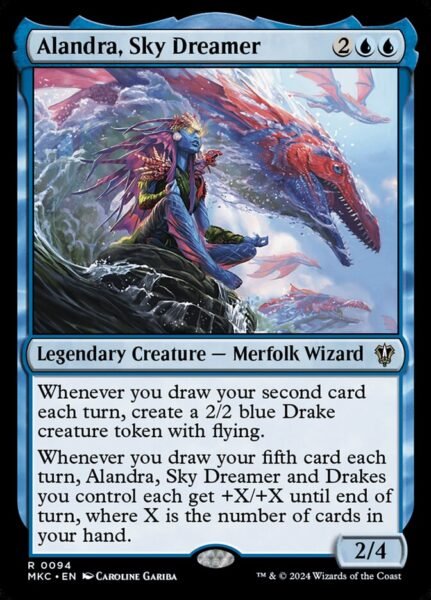
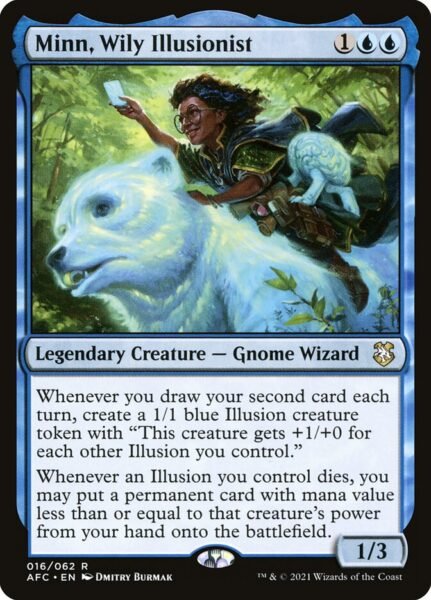
We have 11 creatures that have triggered abilities connected to card draw, seven of which care specifically about the second card we draw a turn.
How’s that for some synergistic jank!
These 11 creatures help us stay alive long enough to stabilize and eventually start attacking by either bringing chump blockers with them or growing large themselves.
To make a long story short (Too late)…our primary game plan is to draw two cards a turn as often as possible by triggering our commander, make an army of token creatures, stick one of our big finishers, and win via combat.
But we have a few tricks up our sleeve! Along with this rather straightforward path to victory, we have a couple of other ways to win the game without combat. More on those later!
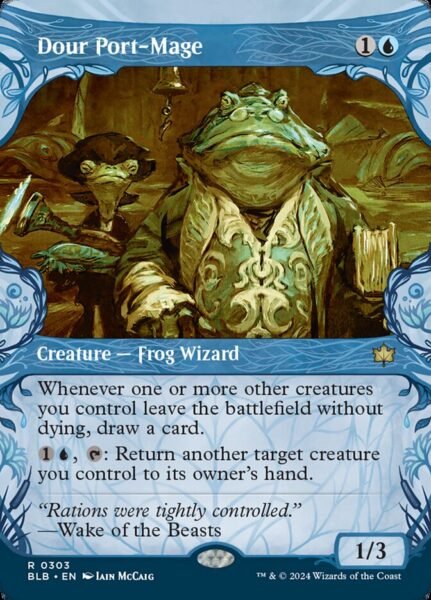
Creatures with Activated Abilities
These make up the bread and butter of our strategy. Without them, our commander will be a vanilla 3/3. I’ve found as many 1- and 2-drop creatures that do something relevant as possible in order to have a creature we can activate on turn 3 when we resolve Elrond, Moon-Reader.
Aetherling – an old-school Control finisher, untapping with this Shapeshifter used to mean game over. In Commander it still can, but death is slow. Still, it is one of our finishers. More importantly, we can activate it on our opponent’s turn for the low cost of or .
Ascendant Spirit – our first 1-drop that we can repeatedly activate. This Spirit can also serve as a finisher, since we can grow it as many times as we have mana once it’s an Angel. And, unlike previous creatures that could be leveled up, we can activate Ascendant Spirit on our opponent’s turn.
Deadeye Navigator – what a perfect card for our deck! Not only does it have an activated ability that is repeatable at instant speed, but it grants another creature the same ability. This and Agent of Treachery are best friends.
Dour Port-Mage – what’s better than activating an ability and drawing an extra card? Drawing two extra cards! This Frog Wizard synergizes with our commander, of course, but we also have enough creatures with enters abilities to target that we will most likely get more value out it than just a single card. One of my favorite plays is to cast Master of Waves early to get chump blockers. Then, once those are all dead, return the Merfolk Wizard to our hand and run it back.
Hangarback Walker – I didn’t count this Construct among my creatures with enters abilities, but it technically has one. More importantly, it is cheap to trigger its activated ability and it brings an army of fliers to help protect our life total or pressure our opponent’s when it dies.
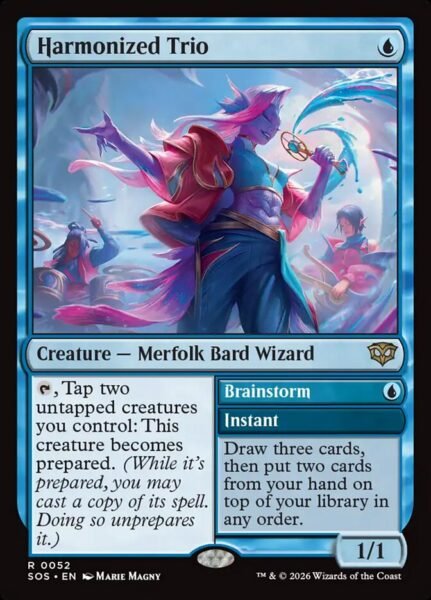
Harmonized Trio – another great fit for our deck. We shouldn’t have a problem putting two other creatures on the battlefield, which should snowball value for us once we’re digging three cards deep every turn.
Ioreth of the Healing House – we aren’t heavy on legendary creatures, but that’s okay. Her first ability is free and lets us target any other permanent, including a land.
Jace, Vryn’s Prodigy – or, we can target this Legendary Creature and get two activations out of it in a single turn! Jace is one of our best means of drawing a second card on our opponent’s turn, thereby triggering our various cards that care specifically about the second card we draw a turn. I also remember when this card was $50, so playing it in a budget deck is both sad and awesome. Sad that so many cards lose their value…and awesome for the same reason. One final reason this card makes me so happy to play is that I ran it in a Bant CoCo deck before that deck became a thing. Getting Jace off of Collected Company at the end of my opponent’s turn only to draw and flip it on my turn to get back the Collected Company was as fun and powerful as it sounds.
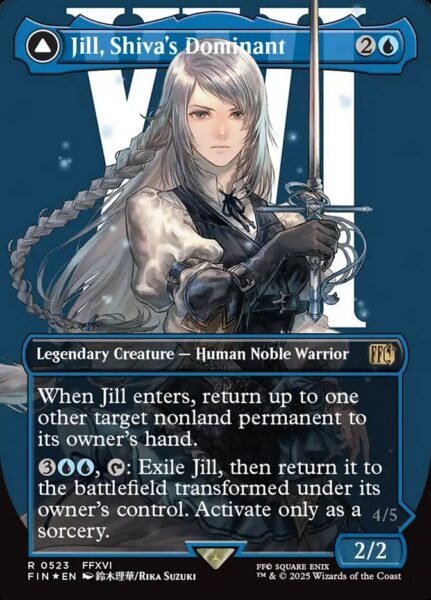
Jill, Shiva’s Dominant – one of our few creatures with both an enters and an activated ability, I highly recommend NOT cutting this Human Noble Warrior. Why?
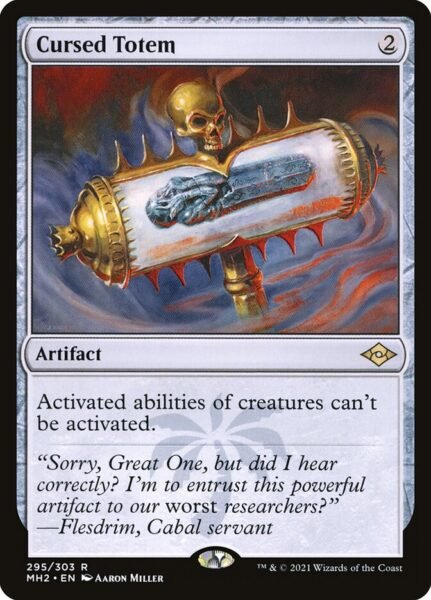
Not sure if casual players even run this hate piece, but I know I play it in a few decks. There are other cards that can hose our activate-draw plan and we want to have some built-in answers to them. Brazen Borrower is now a budget option, but it doesn’t have an activated ability like Jill. Sure, her flipside isn’t amazing, but we mostly want to draw a card with it and we can activate her on our opponent’s turn. Finally, her enters ability can target any nonland permanent, not just our opponent’s, so it will be a rare game that doesn’t have a good target for it.
Jacob Hauken, Inspector – another Jace, Vryn’s Prodigy effect, activating this Human Advisor with our commander out will draw us two cards. If we ever get to transform it, life will be grand!
Kefnet the Mindful – with all of our card draw, we shouldn’t have too much of a problem having seven cards in hand. It’s activated ability is fine. I’d cut this for something more impactful if I weren’t on a budget.
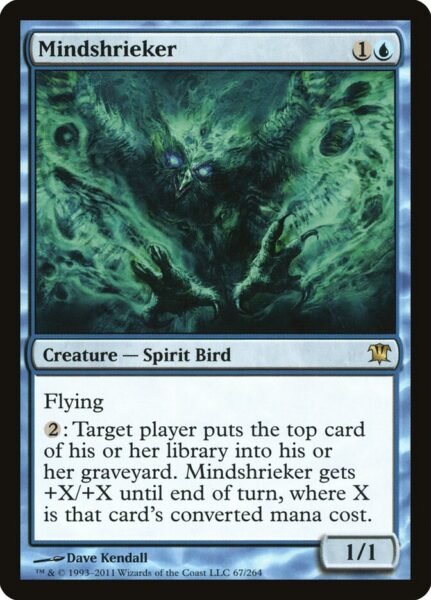
Mindshrieker – this is the kind of card that makes building on a budget so much fun. I loved this card when it was legal in Standard, but it never lived up to my expectations. In this deck, though, we get a repeatable way to draw a card off of Elrond, Moon-Reader on everyone’s turn. And, since Commander decks still have high CMC bombs, we may even get lucky once or twice. Finally, milling our opponent out is actually one of our alternative win conditions and this card helps with that.
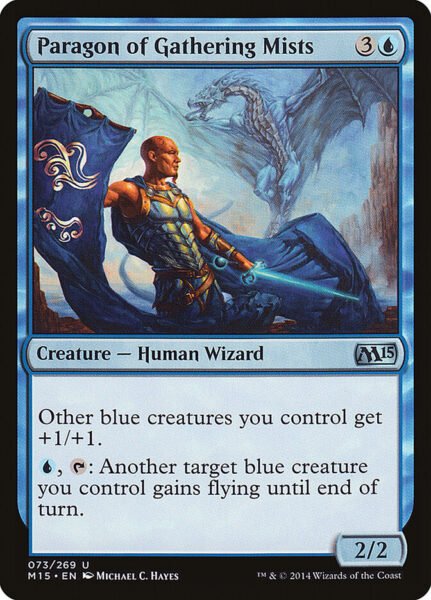
Paragon of Gathering Mists – part of a cycle that gives each color their own Glorious Anthem effect attached to some ability, I’ve had them set aside for a long time, but they rarely make the cut (I play the Green one in my Budget Elf Tribal deck). In our deck, this Human Wizard brings a lot to the table. One of our routes to victory will be by going wide with tokens from cards like Master of Waves and Nadir Kraken. Buffing these will increase our clock. It’s activated ability, meanwhile, is cheap and grants one of the creatures we’ve grown over several turns, like Chasm Skulker, much-needed evasion.
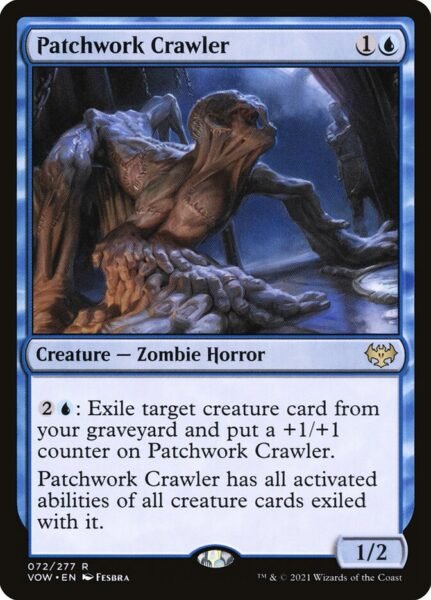
Patchwork Crawler – a diamond-in-the-rough for us, this Zombie Horror is a perfect fit for our deck. Sure, it’s activated ability is pricey, but once we’ve exiled one of our creatures with a cheaper, more powerful ability, we can go about our business and pay the only when we want to. What makes this card so fun is that our opponent will be very unhappy to see us exile the creature they hated enough to use a kill spell on. Finally, that art is seriously creepy. Well done Fesbra!
Rishadan Dockhand – speaking of annoying our opponent… This Merfolk is a catch-all to all those utility lands that will also draw us a card with our commander out. Now that’s value!
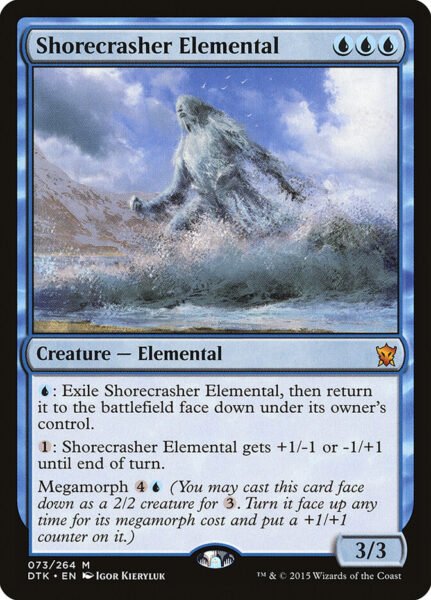
Shorecrasher Elemental – I’m not sure anyone thought this card would be good when it was first spoiled. However, it’s perfect in our deck as a , draw a card creature that we can activate on everyone’s turn.
Spellskite – we’re using a chunk of our budget (more than $7) on this one, but it’s totally worth it. Not only does it give us a bit of protection, it’s a free, repeatable activation, albeit one not entirely in our control.
Thassa, God of the Sea – besides smoothing out our draws, the to make one of our creatures unblockable is the main reason this God is in our deck. We can activate it on our opponent’s turn, as well. Finally, since we play a bunch of Blue permanents, this should be a 5/5 indestructible creature most of the time, making it one of our bombs.
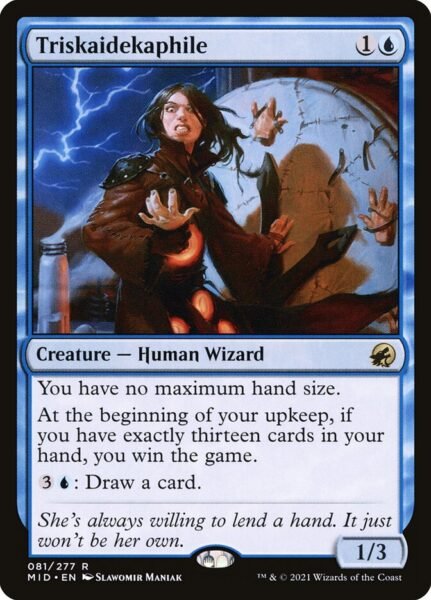
Triskaidekaphile – oh yeah! This card is SO good in our deck. We never want to discard to hand size, while having an achievable alternative win condition increases the power of an otherwise somewhat durdly deck. We can activate her on our opponent’s turn, as well.
Troop of Ponies – playing this on turn 2, followed by our commander, lets us draw a card, ramp, and have a fourth land drop on turn 4. I really think this card will see a ton of play in Commander as a color fixer/ramp spell for non-Green decks.
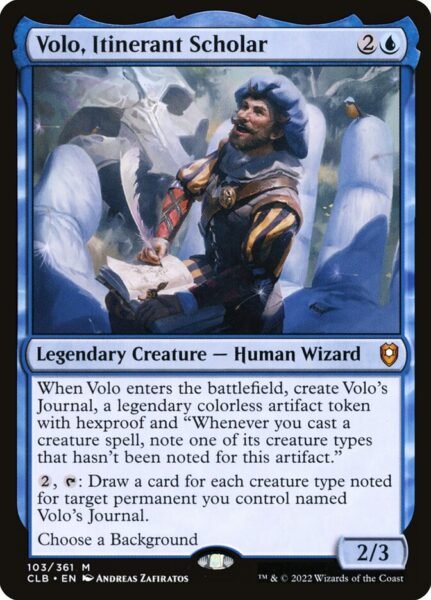
Volo, Itinerant Scholar – as I get to the last creature of this section, I’m struck by the fact that this deck feels full of not-good-enough Blue creatures who have finally found a home in which to shine! Blue has lots of ways to draw cards and typically doesn’t play a lot of creatures, making this Human Wizard’s enters ability pretty meh. For us, though, we play 27 different creature types. However, even if we only have Volo and our commander out, we’ll be drawing three cards for just . Not too shabby.
Card Draw Payoffs
Drawing extra cards is a great way to stay flush with action, answers, and threats, but your deck actually has to play real threats for this to work. Among our creatures with activated abilities, we have a few big bombs, but none that will have our opponents shaking in their boots. These are the cards we want to resolve once we have our commander and some activated abilities online. And while they may not win quickly, they do give us a real line to victory via combat.
More importantly, their jank level is high!
Alandra, Sky Dreamer – a nod to Talrand, Sky Summoner, which is nearly strictly better, Alandra is the more powerful choice for our deck. Not only are we well-equipped to make a 2/2 Drake on our turn and on our opponent’s, drawing five cards in a single turn is also well within our reach. At nearly $10, this Merfolk Wizard is one of our most expensive cards, but it’s totally worth it. In the early to mid-game we can use the tokens to protect our life total. Late, we can use them to close out games quickly.
Chasm Skulker – a true guilty pleasure card for me that just happens to synergize extremely well with our deck. We can grow this Squid Horror to massive proportions, but just don’t count on it ever dying, given how much exile-based removal is in the format. That’s okay, though, as we are happy if we only use it as a must-answer threat that can win games quickly, particularly if we make it unblockable with Thassa, God of the Sea.
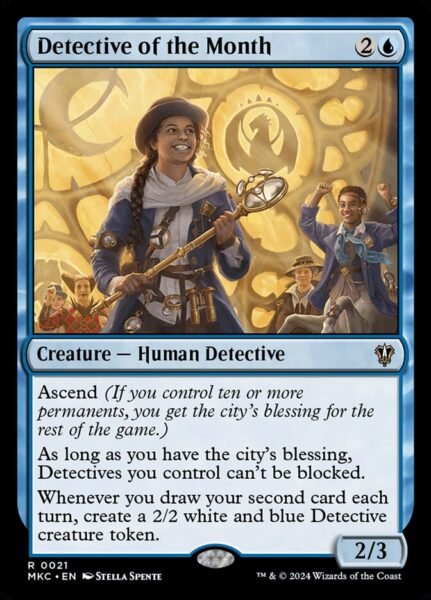
Detective of the Month – Murders at Karlov Manor may not have been the most well-received, but this card is great for us! It’s our third token generator and, in case you didn’t notice, each of these tokens come with some kind of evasion. Flying, islandwalk, and now unblockable. So, while these payoffs are perhaps easy to dismiss on the surface as janky, the reality is that they present powerful game-ending threats if left unanswered.
Ethereal Investigator – another token generator tied to the second card we draw each turn. This time, we get 1/1 flying Spirits. The enters ability isn’t much since I largely play Duel Commander, but for those who play with three opponents, the Clues you’ll get will help ensure you can draw a second card a turn multiple times.
Faerie Vandal – one of our more unimpressive payoffs, it does have the potential to become a decent threat. Flash is nice.
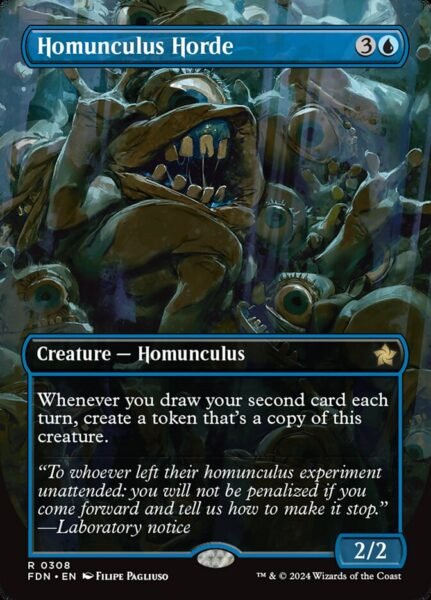
Homunculus Horde – every budget deck I build brings me joy, but the best part is finding that diamond-in-the-rough card that lives its best life specifically in our deck (and maybe nowhere else). Homunculus Horde is that card. With the right set-up, we can untap with four copies of this card on turn 5 and be off to the races of challenging math.
Minn, Wily Illusionist – this Gnome Wizard from an Adventures in the Forgotten Realms Commander Precon went printed without me noticing. When I found it while searching for creatures who care about the second card drawn a turn, I knew I had to make room for it in the budget (nearly $9). Everything this card does is relevant in our deck. The army of Illusions we can make will, like all the other token generators in this section, help us stay alive or close out games. The second block of text, meanwhile, is something we are well-positioned to take advantage of, given how many cards we draw. We will rarely only have one or two to pick from when this triggers.
Mischievous Mystic – not sure why Wizards decided to put a bunch of new cards that care about the second card drawn in a turn in Foundations, but I’m glad they did! This Human Wizard feels the most pushed, if I’m honest. A 2-mana flier that makes 1/1 fliers is great for us.
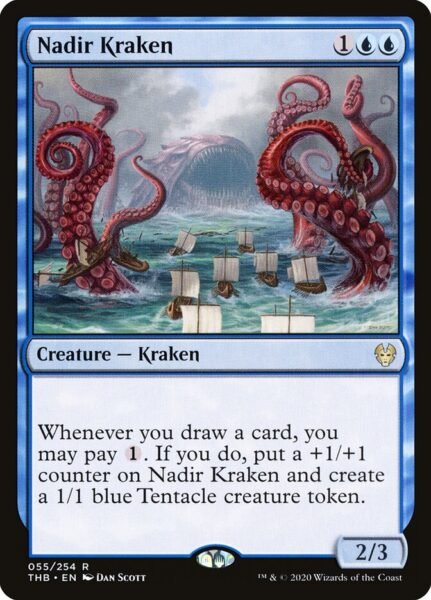
Nadir Kraken – another guilty pleasure card for me. I’ve taken this out of my binder countless times to put in decks only for it to never make the cut. For us, however, we can really take advantage of both the +1/+1 counters and the token generation. If you’ve never played it, you get to look at the card you draw before you decide to pay the .
Oneirophage – this card was first printed in Modern Horizons, which makes you wonder why it’s not more powerful! Flying means the is acceptable, though otherwise it wouldn’t make the cut.
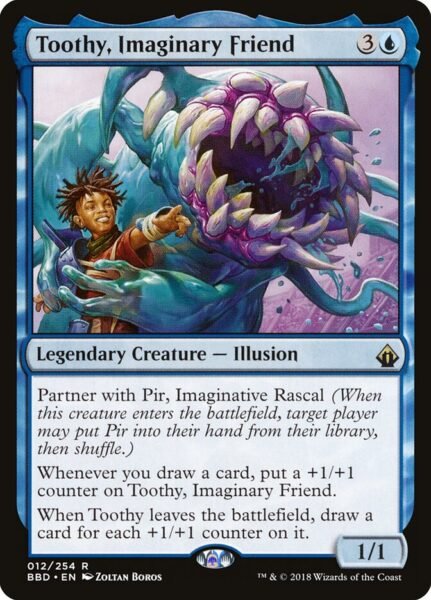
Toothy, Imaginary Friend – if this card only grew itself, we wouldn’t play it. The card draw we get whenever it LEAVES the battlefield makes it an all-star for us and a must-answer threat for our opponents.
Drawing Our Second Card
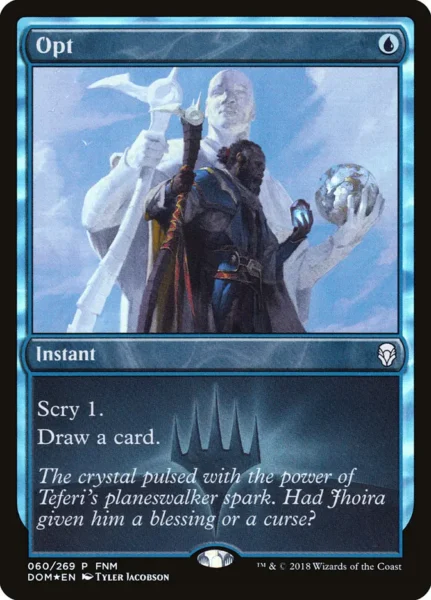
With seven cards that care about us drawing our second card in a turn, we want additional ways beyond our commander’s static ability to achieve this. Not only will this allow us to more reliably draw two cards on an opponent’s turn, it will also give us flexibility in how and when we want to use an activated ability to draw one of the following 16 cards. I’ve talked about several of these, while others are simple cantrips. I’ll keep my commentary to a minimum.
Archmage’s Charm
Boomerang Basics – I wouldn’t blow this one on one of our permanents if possible since we have a limited number of ways to deal with hate cards like Cursed Totem.
Consider
Dour Port-Mage
Harmonized Trio/Brainstorm
Jace, Vryn’s Prodigy
Jacob Hauken, Inspector
Kefnet the Mindful
Opt
Preordain
Serum Visions
Sphinx’s Tutelage
Think Twice – I know there are cantrips with a better rate, but I just really like this card. I see it as us paying instead of to get the chance to recast it for its flashback cost at our convenience.
Triskaidekaphile
Volo, Itinerant Scholar
Wizard Class – this happens to be one of our finishers, as well.
Alternative Win Conditions
It’s not every day I play a Commander deck with three alternative ways to win outside of combat. And while the likelihood of these winning us games may seem farfetched, I’ve already won one game via noncombat. Can you guess which one?
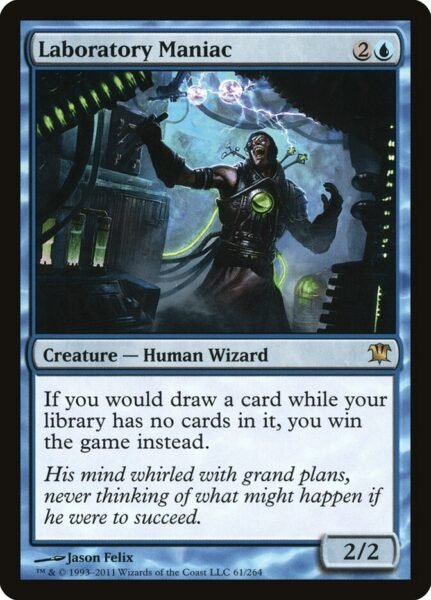
Laboratory Maniac – I originally had Jace, Wielder of Mysteries in this spot, but our budget made me cut the Planeswalker. I would most definitely play Jace over Laboratory Maniac all things considered. But lets talk about the chances of us winning thanks to no cards in our library. Between our commander’s static ability and our various ways of drawing cards, we have 33 ways to draw extra cards. Of these 33, a couple have the ability to draw us a huge number: Volo, Itinerant Scholar and Toothy, Imaginary Friend. I don’t know the odds this gives us of drawing through our deck but I know I’m worried enough about drawing too many cards that I want to include Laboratory Maniac as a safety net.
Triskaidekaphile – having 13 cards in hand seems much more achievable.
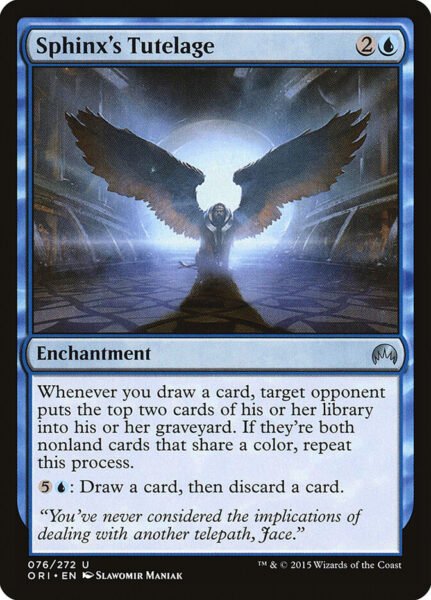
Sphinx’s Tutelage – milling out our opponent is also a real possibility with the number of cards we draw. And if you guessed this was my alternate win condition victory, then you guessed right! I love Mill and while the game was pretty unexciting, a wins a win and it was nice to see my plan come together.
Interaction
Being a Mono Blue deck limits the ways we have of dealing with permanents. Counter magic is obviously our most efficient and clean method, but we all know that you can’t counter everything. Furthermore, I have a Mono Blue Control deck already and don’t want to play the same suite of answers here as there. Yes, we are playing a handful of counter spells, but I’ve left out some of the bounce spells that help reset the board temporarily.
Our main method of handling creatures is to make them irrelevant.
Eaten by Piranhas – this is what I mean. Big bomb giving us issues? Let’s make it into a 1/1 Skeleton! There is, of course, risk to this strategy. Many threats have hexproof. Our opponent can have a protection spell. Enchantments can be removed. However, I like these cards as efficient, even if temporary, answers to buy us time to get our gameplan online.
Honest Work – you can see the evolution of these kinds of answers. Wizards realized that making a creature with counters a 1/1 doesn’t do enough and so gave us this answer. Thank you!
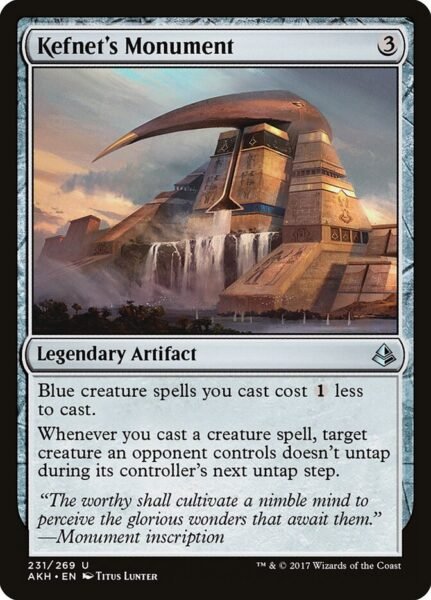
Kefnet’s Monument – mostly here to make our creature spells cheaper, we can also keep an opponent’s tapped creature tapped a turn, which can buy us the time we need or prevent our opponent from attacking for fear we will lock their creature down.
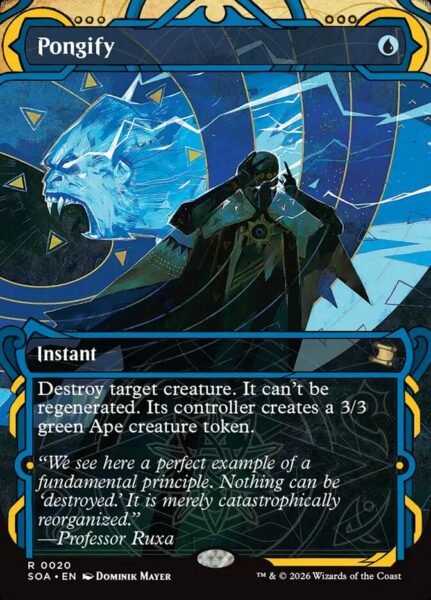
Pongify – it’s kind of sad that many of our creatures will lose in combat to the 3/3 Ape we give our opponent with this, but that’s still better than whatever we killed.
Rapid Hybridization – I nearly always write this as Rabid Hybridization and I think that’s a better name.
Witness Protection
Protection
Rather than a bunch of counter magic to keep our commander (or best threat) alive, we have some cheap ways to protect a creature from targeted removal.
Magic Damper
Octopus Form
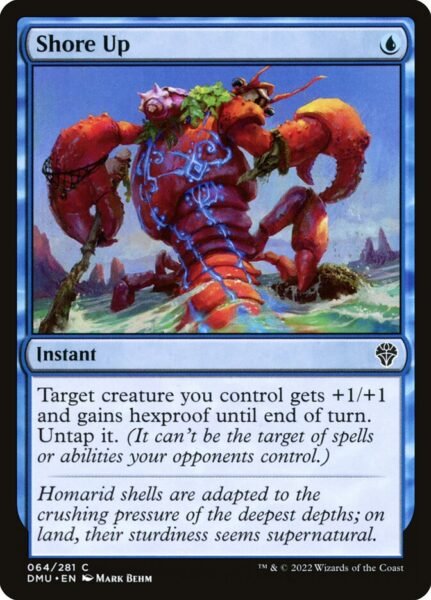
Shore Up
Support
I’ve detailed the many synergies of our deck above, but I can’t finish this article without talking about this card.
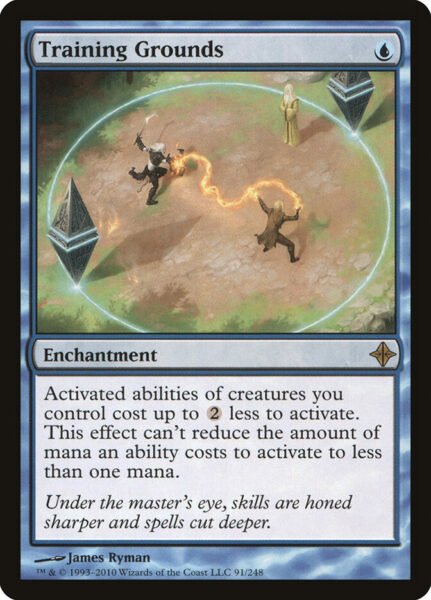
Training Grounds – I’ve never found a home for this card, as it always looks better on paper than in the decks I considered putting it in. However, in this deck, the 1-mana enchantment is a superstar!
Flex Spots
Per usual, cutting a single card or two from any one section of the deck is a reasonable way to make room for whatever card(s) you want to play or consider better in your meta. Or if you have more of a budget, of course. Here are some of the cards I would cut if I had another $20 or so.
Out:
Kefnet the Mindful
Faerie Vandal
Consult the Star Charts
Laboratory Maniac
Shore Up
In:
Emeritus of Ideation
Sapphire Medallion
Cryptic Command
Jace, Wielder of Mysteries
Slip Out the Back
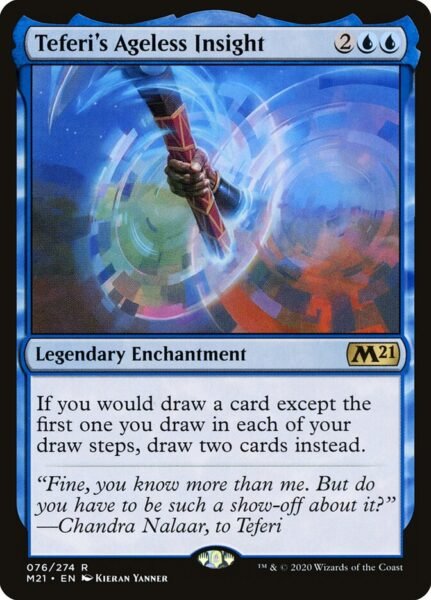
I would be remiss if I didn’t at least mention Teferi’s Ageless Insight. The cheapest copy is under $4 so it’s not something we couldn’t play. Going through my binders the first time, I simply missed it. But now that the deck is built, I’m not sure it’s necessary. Yes, drawing two cards instead of one is undeniably powerful, but it seems like a win-more card for us. Still, I wouldn’t blame anyone for playing the legendary enchantment in this deck.
Ideal Hand and Game Play
We want at least one creature we can cast on turn 1 or 2 that has an activated ability, preferably one that is free to use. This way we can immediately draw a card on turn 3 after resolving our commander. Otherwise, a cantrip to set up our draw, some removal or counter magic, and three lands would round out a solid starting hand for us. More than one creature with an activated ability is ideal.
Along the way, we’d like to draw a token generator in order to protect our life total and give us an end game. Since we are set up to draw a lot of cards, it shouldn’t be too hard for us to find what we need.
Weaknesses
This is not a fast or aggressive deck. Our creatures are here mainly to draw us cards until we find a finisher. Against Aggro, we can die before we get much online. If our opponent plays a bunch of sweepers or spot removal, then we could have trouble rebuilding or keeping our commander on the battlefield to draw us cards. Meanwhile, our finishers need both time and some investment to win us games.
What this means is that even when we are ahead on board, our opponent will have plenty of time to draw their way back into the game.
Conclusion
I originally thought Elrond, Moon-Reader may lead to a similarly unique, fun, and powerful budget deck as Kirol, Attentive First-Year did. Unfortunately, we don’t have the kind of powerful synergies that deck has that lets it compete with more expensive decks.
The good news, though, is this deck IS super fun and pretty janky. Many of the cards we’re playing as part of our strategy probably don’t see play in many other decks. I love that we make a ton of tokens by drawing a ton of cards. The former is not really something Blue does well or often, while the latter is where the color excels. Putting the two together makes for an interesting and fun-to-play deck.
If you’re looking for a non-traditional Mono Blue Commander deck that still draws cards but wants to win via a go-wide or go-big strategy, give Elrond, Moon-Reader a shot!
Let me know what you think and how you’d build a deck around Elrond. Thanks for reading and watching!