by Johnny Cycles, July 24th, 2026
Be sure to subscribe to my YouTube channel to support my content and see the videos before they make it to this site!
Hello and welcome to the second installment of my Learning Magic series. These decks are designed for beginners just learning the game. They are all a single color with a basic mana base (all basics, but for Cavern of Souls) and have a straightforward gameplan that will be easy to understand. Of course, that doesn’t mean the cards I’ve chosen are all vanilla Grizzly Bears. After all, we want whoever is learning the game to want to keep playing it!
The cards have plenty of text, synergies, mechanics, and more. Furthermore, the strategy this deck employs (synergistic, go-wide) requires both skill and a certain amount of finesse. As the new player learns the deck, this will hopefully become clear. That being said, it is entirely possible to play this deck without really looking at the text box. Regarding its creatures, mana value and power and toughness can be the only things to consider, depending on how young the player is. The various noncreature elements will require a bit more reading, but many are very straightforward.
I’m providing both a nonbudget and budget version of the deck. I envision this kind of deck being one an experienced player builds and uses to teach others how to play. With this in mind, many of the expensive cards are likely in their collection. If not, there’s the budget-friendly version, as well as a long list of cards that can be swapped in based on what you own.
What this Deck Teaches
Besides the nuts and bolts of the game, this deck will teach players the following:
- Nuances of combat – when to attack into a board of creatures and when to wait;
- Power of synergy – how individual cards work together to become more powerful;
- Searching your library – the power of being able to find silver bullets in your deck;
- Enters effects and blinking – built-in 2-for-1s and how to gain extra value out of them;
- Keywords – lifelink, first strike, vigilance, protection, etc.; and
- How not to overextend into a sweeper.
As you can see, there is a lot more going on in this deck then simply land drops and creatures up the curve. Furthermore, the above list varies in complexity. Keywords are pretty simple to understand. The nuances of combat is something I’m still mastering…
Now, let’s get to the deck!
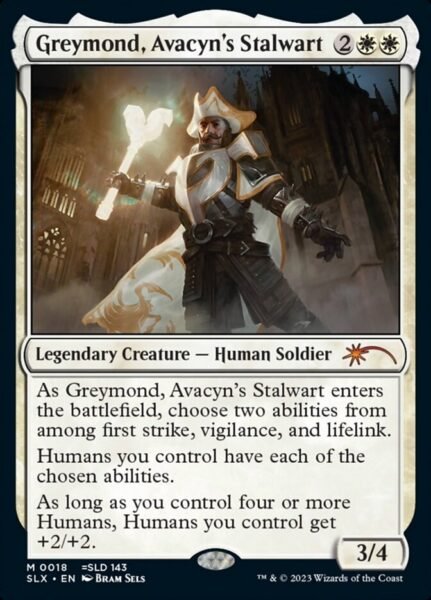
Decklist – Mono White Humans with Greymond, Avacyn’s Stalwart
| Greymond, Avacyn’s Stalwart |
Creatures (36) – Total Cost: $226.57
| Champion of the Parish | $1.04 |
| Dragon Hunter | .25 cents |
| Esper Sentinel | $60 |
| Guide of Souls | $2.90 |
| Soldier of the Pantheon | .38 cents |
| Thraben Inspector | .25 cents |
| Charming Prince | .54 cents |
| Cloud, Midgar Mercenary | $22 |
| Coppercoat Vanguard | .36 cents |
| Grand Abolisher | $17 |
| Hidden Dragonslayer | .26 cents |
| Sanctifier en-Vec | .40 cents |
| Shepherd of the Flock | .24 cents |
| Stoneforge Mystic | $31 |
| Thalia, Guardian of Thraben | .54 cents |
| Thalia’s Lieutenant | .99 cents |
| Voice of Victory | $19 |
| Adeline, Resplendent Cathar | $2.11 |
| Banisher Priest | .20 cents |
| Cosmogrand Zenith | $6 |
| Fiend Hunter | .25 cents |
| Haliya, Guided by Light | $2.22 |
| Loran of the Third Path | $5.10 |
| Mirran Crusader | .49 cents |
| Ranger-Captain of Eos | $41 |
| Recruiter of the Guard | $5.86 |
| Thalia, Heretic Cathar | $1.22 |
| Verge Rangers | .31 cents |
| Cemetery Protector | .97 cents |
| Faramir, Field Commander | .21 cents |
| Hero of Bladehold | .63 cents |
| Keeper of the Accord | .52 cents |
| Kwende, Pride of Femeref | .24 cents |
| Odric, Master Tactician | .48 cents |
| Ranger of Eos | .88 cents |
| Riders of Gavony | .34 cents |
Artifacts (7) – Total Cost: $142.03
| Pearl Medallion | $5 |
| Sword of the Animist | $3.59 |
| Buster Sword | $48 |
| Herald’s Horn | $2.44 |
| Sword of Feast and Famine | $36 |
| Sword of Fire and Ice | $28 |
| Sword of Hearth and Home | $19 |
Enchantments (8) – $15.86
| Authority of the Consuls | $4.71 |
| Honor of the Pure | .70 cents |
| Rally the Ranks | .50 cents |
| Always Watching | .96 cents |
| Sanctuary Lockdown | .25 cents |
| Spear of Heliod | $1.19 |
| War of the Last Alliance | $1.45 |
| Cathars’ Crusade | $6.10 |
Instants (7) – Total Cost: $46.04
| Cloudshift | $1.19 |
| Ephemerate | $4.84 |
| Path to Exile | $1.21 |
| Swords to Plowshares | $1.40 |
| Declaration in Stone | .40 cents |
| Flawless Maneuver | $22 |
| Akroma’s Will | $15 |
Sorceries (3) – Total Cost: $1.48
| Beyond the Quiet | .39 cents |
| Hallowed Burial | .69 cents |
| Terminus | .40 cents |
Lands (38) – Total Cost: $50
Cavern of Souls $50
Plains (37)
Total Cost: $481.98
That ain’t cheap! Per usual, the bulk of the cost of this deck is in only a handful of cards. Some we won’t miss that much, but others, like the Equipment and the tutors, will definitely have an impact on the power level and the consistency of the deck. That being said, there ARE budget options for both. But first, let’s list the expensive cards.
Creatures
Esper Sentinel $60
Cloud, Midgar Mercenary $22
Grand Abolisher $17
Voice of Victory $19
Stoneforge Mystic $31
Ranger-Captain of Eos $41
Equipment
Buster Sword $48
Sword of Feast and Famine $36
Sword of Fire and Ice $28
Sword of Hearth and Home $19
Instants
Flawless Maneuver $22
Akroma’s Will $15
Lands
Cavern of Souls $50
Total: $408
Cutting these reduces the following: card draw, stopping spells on our turn, equipment/protection, instant-speed protection, and Cavern of Souls. That’s 13 cards we have to replace.
There are a couple of ways we can approach this. First, we can find budget options to replace each of the cards and what they bring to the table as best as we can. Specifically regarding the Equipment, we could replace the swords with the following:
Blackblade Reforged $3.08
Forebear’s Blade .31 cents
Sword of Light and Shadow $7.22
Sword of Vengeance $1.17
Total Cost: $11.78
Unfortunately, only the Sword of Light and Shadow brings any kind of protection to help us punch through damage. Two, however, do give trample, which will serve a similar purpose.
But we need more protection in general to keep our suited up attackers alive.
Blacksmith’s Skill .25 cents
Brave the Elements .42 cents
Restoration Magic $1.73
Ultimate Magic: Holy .60 cents
Total Cost: $3
Each of these spells can protect a creature from targeted removal and damage-based sweepers. They can also be used before we attack to ensure at least one creature makes it through. Brave the Elements is our best for closing out a game.
But there’s another way we can approach this problem: tapping our opponent’s creatures down.
Court Street Denizen .20 cents
Devout Chaplain .29 cents
Lossarnach Captain .44 cents
Total Cost: .79 cents
Each of these offers a repeatable way to tap down our opponent’s best blocker(s).
Replacing card advantage will be a bit trickier, particularly the tutors.
Regarding card draw, we have a lot of options for creatures who dig for other creatures of certain mana values.
Airlift Chaplain .20 cents
Jet, Rebel Leader .33 cents
Recruitment Officer .25 cents
Or, we can take a different approach.
Dawn of Hope .37 cents
I’m going with Dawn of Hope. The enchantment can help us rebuild after a sweeper, albeit slowly, and we have both incidental lifegain and a commander who can grant lifelink to help us draw cards in the mid- to late-game.
As to the tutors…well, there are two I’m considering.
Honored Knight-Captain .24 cents
Thalia’s Lancers .50 cents
We already have one way to tutor up legendary creatures, so I’m going to go with Honored Knight-Captain. It brings a 1/1 Human token with it, so we get value on the front end. Paying to get an Equipment and put it on the battlefield is no Stoneforge Mystic, but we’ll take it!
Total Cost: .61 cents
Honestly, we could even go cheaper by next cutting some of the $5+ cards. I’ll let you make that choice, though.
Here’s my final budget list:
Decklist – Budget Mono White Humans with Greymond, Avacyn’s Stalwart
| Greymond, Avacyn’s Stalwart |
Creatures (34) – Total Cost: $37.74
| Champion of the Parish | $1.04 |
| Dragon Hunter | .25 cents |
| Guide of Souls | $2.90 |
| Soldier of the Pantheon | .38 cents |
| Thraben Inspector | .25 cents |
| Charming Prince | .54 cents |
| Coppercoat Vanguard | .36 cents |
| Devout Chaplain | .29 cents |
| Hidden Dragonslayer | .26 cents |
| Honored Knight-Captain | .24 cents |
| Sanctifier en-Vec | .40 cents |
| Shepherd of the Flock | .24 cents |
| Thalia, Guardian of Thraben | .54 cents |
| Thalia’s Lieutenant | .99 cents |
| Adeline, Resplendent Cathar | $2.11 |
| Banisher Priest | .20 cents |
| Cosmogrand Zenith | $6 |
| Court Street Denizen | .20 cents |
| Fiend Hunter | .25 cents |
| Haliya, Guided by Light | $2.22 |
| Loran of the Third Path | $5.10 |
| Mirran Crusader | .49 cents |
| Recruiter of the Guard | $5.86 |
| Thalia, Heretic Cathar | $1.22 |
| Verge Rangers | .31 cents |
| Cemetery Protector | .97 cents |
| Faramir, Field Commander | .21 cents |
| Hero of Bladehold | .63 cents |
| Keeper of the Accord | .52 cents |
| Kwende, Pride of Femeref | .24 cents |
| Lossarnach Captain | .44 cents |
| Odric, Master Tactician | .48 cents |
| Ranger of Eos | .88 cents |
| Riders of Gavony | .34 cents |
Artifacts (7) – Total Cost: $22.81
| Pearl Medallion | $5 |
| Blackblade Reforged | $3.08 |
| Sword of the Animist | $3.59 |
| Forebear’s Blade | .31 cents |
| Herald’s Horn | $2.44 |
| Sword of Light and Shadow | $7.22 |
| Sword of Vengeance | $1.17 |
Enchantments (9) – $16.23
| Authority of the Consuls | $4.71 |
| Dawn of Hope | .37 cents |
| Honor of the Pure | .70 cents |
| Rally the Ranks | .50 cents |
| Always Watching | .96 cents |
| Sanctuary Lockdown | .25 cents |
| Spear of Heliod | $1.19 |
| War of the Last Alliance | $1.45 |
| Cathars’ Crusade | $6.10 |
Instants (9) – Total Cost: $12.04
| Blacksmith’s Skill | .25 cents |
| Brave the Elements | .42 cents |
| Cloudshift | $1.19 |
| Ephemerate | $4.84 |
| Path to Exile | $1.21 |
| Restoration Magic | $1.73 |
| Swords to Plowshares | $1.40 |
| Declaration in Stone | .40 cents |
| Ultimate Magic: Holy | .60 cents |
Sorceries (3) – Total Cost: $1.48
| Beyond the Quest | .39 cents |
| Hallowed Burial | .69 cents |
| Terminus | .40 cents |
Lands (37)
Plains (37)
Total Cost: $90.16
Nice! We have $10 to spare, should we want to splurge and find some other, more expensive substitutes. Now, let’s get to the deck! This time around, I’m going to talk about my nonbudget deck. The detailed discussion of the changes I made to make the deck budget should be enough to fill in the blanks. Both decks, however, have the same game plan.
Deck Tech
Primary Game Plan
This deck is what is known as a White Weenie Deck. We are an aggressive, low-to-the-ground creature strategy looking to buff our team with Glorious Anthem effects, suit them up with powerful Equipment, protect our key pieces, and turn everything sideways until our opponent is dead. We want to have at least four Humans on the battlefield as fast as possible in order to gain the +2/+2 buff from our commander. For this reason, about half of our creatures cost 1 or 2 mana.
Of course, as simple as this sounds, the deck is a synergistic thing of beauty, as nearly every card works with at least one other to become more powerful than itself.
As to secondary game plans… Who needs one of those?
Seriously, though, we don’t really have one. The deck is full of different ways to achieve our primary game plan, but we will not win any games without attacking. This is both intentional and a result of the archetype. A player new to Magic doesn’t need to be overwhelmed with too many different strategies in a given deck. There is already a lot to read and remember.
Our deck can be divided into the following parts: our army of Humans; Glorious Anthem effects; Equipment; protections spells; removal; card draw; and ramp. What is so fun about this deck, however, is that many of these categories also appear among our army of Humans.
Army of Humans
36 of our 37 creatures are Human. I know, I know… My tribal theme is totally shot, now. I just couldn’t resist the power and synergy of Stoneforge Mystic. Our creatures can be divided into categories, many of which align with the deck’s overall categories. First, we have our army of attackers. These are the Humans who will do the heavy lifting of beating down our opponent. Next, we have humans who either draw us cards or tutor up cards. Third, we have anthem effects attached to Humans. Fourth, removal. Fifth, protection. Sixth, Humans who tax our opponent in such a way as to help us achieve victory. And finally, our finishers.
The Beaters
In this category are the Humans who hit early and often, frequently bringing more creatures to the party. These cards are essential both to our gameplan and to turning on our commander’s clause of us controlling four or more Humans.
Adeline, Resplendent Cathar – this Human Knight is everything a White Weenie deck wants. She is cheap to play. She attacks and blocks. Her power can grow to massive proportions. And, she brings her own army to the table. Sure, Commander is full of big bombs that will quickly outclass this 3-drop, but with the number of ways we have to pump our team, we’re counting on her surviving most combat.
Cemetery Protector – 4 mana is a lot for us, so we better be getting a ton of value from this card. Alas, I’m kind of on the fence about this Human Soldier. The flash is a great way to play around sweepers, while the 1-time graveyard hate is nice. The potential 2-for-1 with each land or creature (we should almost always exile a creature) is great. I don’t like that we only exile a card upon entering, rather than attacking, as well, though I suppose this latter would be pretty busted. Still, in today’s Magic, I think it’s reasonable. Second, 4 mana is a lot…
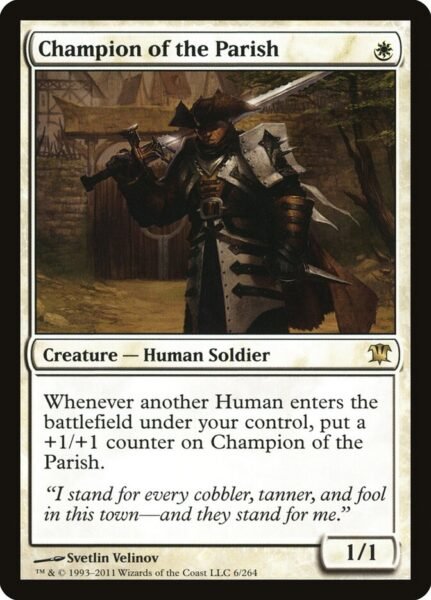
Champion of the Parish – we want 1-drops for a bunch of reasons, first and foremost to get to that magic number 4. We also have multiple ways to tutor up 1-drops. Champion of the Parish is an amazingly powerful card and can grow to epic proportions if left unanswered.
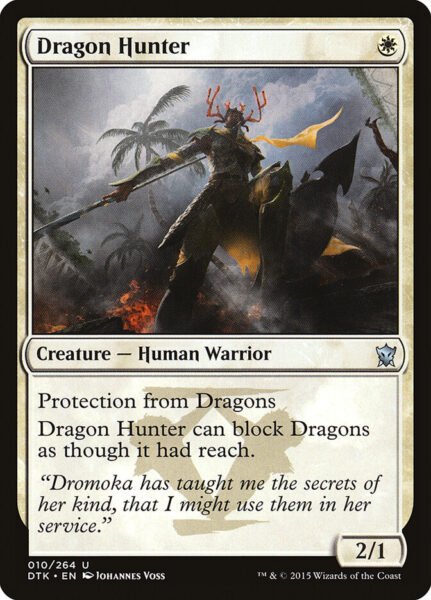
Dragon Hunter – this card probably seems like an odd choice, but since my meta includes a Mono Red Dragon deck, I’m including this both as a flavor win and as a real answer to all the flying, hasty Dragons my son will be attacking me with.
Guide of Souls – perhaps the best 1-drop Human ever printed, this Human Cleric will provide us with some much needed evasion if left unanswered.
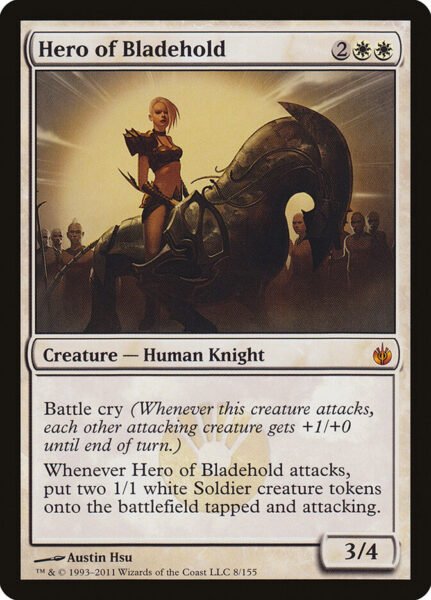
Hero of Bladehold – a 4-drop that buffs our team, while also bringing with it an army? Yes! If only her tokens were Humans…
Keeper of the Accord – another card that can build up an army in the right spot, it also doubles as ramp when we have less lands than an opponent.
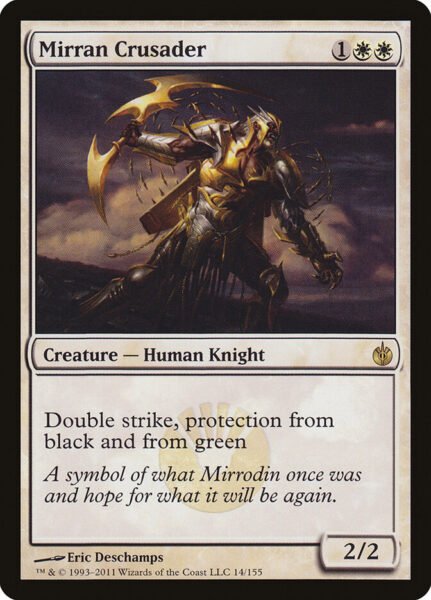
Mirran Crusader – with a curve that ends at 4, we definitely lack traditional game-ending bombs. With a commander that can give our Humans +2/+2 and two keywords, we don’t need them as much as many decks. That being said, what we do want is protection from various colors so that we can close out games on stalled boards. Sure, Mirran Crusader‘s protection from Black and Green may be useless in some match-ups, but its double strike rarely will. Furthermore, when its protection IS good, it can be game ending.
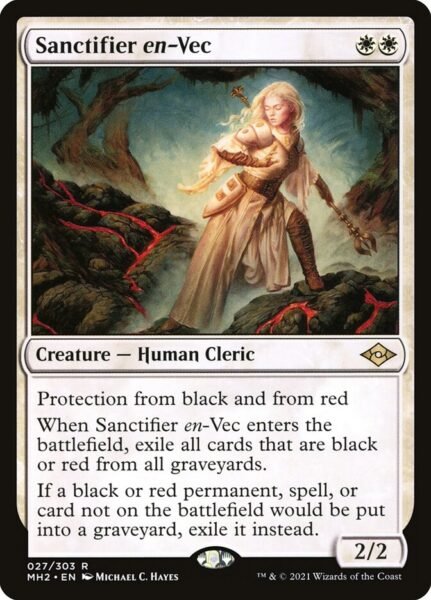
Sanctifier en-Vec – ditto all of that for this 2-drop, minus the double strike. Still, its hate on the graveyard against two colors that love graveyard shenanigans more than makes up for its lack of double-strike.
Soldier of the Pantheon – more protection, this time from multicolored.
Thalia’s Lieutenant – growing all of our other Humans +1/+1 on entering makes this one of our better late-game 2-drop draws. With our many ways of blinking it, we have the potential to turn this Human Soldier into a game-ender. Furthermore, it will grow with every Human we resolve afterwards.
Voice of Victory – another powerful 2-drop, this one brings with it 2 1/1 Warrior tokens when it attacks. These 1/1s won’t synergize with everything we’re doing, but, alongside shutting down our opponent’s instants on our turn, Voice of Victory brings too much value for this to be an issue.
Card Advantage
Many of our Humans also bring with them card advantage. This isn’t always in the form of card draw. We also get to tutor up cards with many of them. Experienced players will immediately notice the absence of Mentor of the Meek. I had it, alongside Enduring Innocence, as auto-includes before I realized that our many ways of growing our team will more often than not prevent us from ever drawing cards off of these two.
Charming Prince – yes, this is neither card draw, nor a tutor, but I’m including it here because nearly all of our best targets for its third ability will either draw us a card or tutor up something. A 2-drop that scrys 2 will also allow us to keep some land-light hands, while the 3 life, probably the mode we’ll select least, will draw us a card with Haliya, Guided by Light out.
Cloud, Midgar Mercenary – I passed over this expensive ($$$) mythic on my first pass when building this deck. Then I realized how on-theme having swords in the deck would be and put in Stoneforge Mystic. Cloud is better in many ways in our deck. It’s a Human, first and foremost. Second, its static ability that doubles our Equipment triggers is far more relevant than cheating something into play for , since we aren’t running high mana costing equipment.
Esper Sentinel – this Modern staple is not as impactful in Commander, but it still can cause our opponents problems if we’re lucky enough to get it down early. Late, with all of our anthem effects and Equipment, we can really tax our opponent’s noncreature spells.
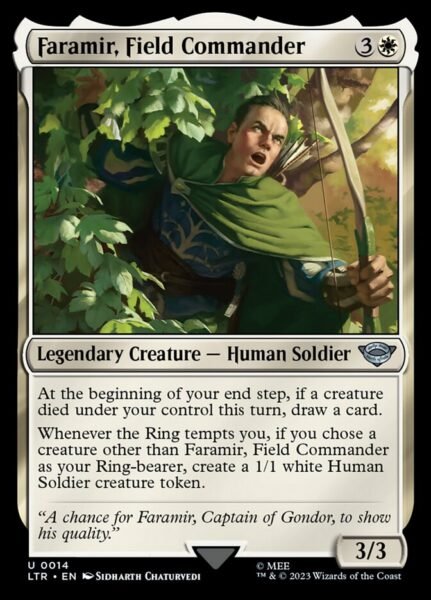
Faramir, Field Commander – replacing a creature we lose in combat goes a long way in keeping our hand full of action. The second block of text is mostly irrelevant in our deck, except when we’re lucky enough to find War of the Last Alliance.
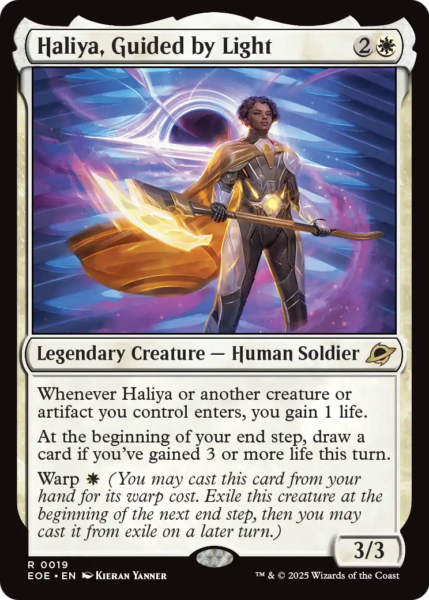
Haliya, Guided by Light – with our commander out, we can gain a ton of life every turn to trigger this Human Soldier. Even without it, though, we play a lot of incidental lifegain to get value out of this card.
Loran of the Third Path – in Duel Commander, we’ll have to be pretty desperate to draw a card with this, but in normal Commander, this can be a means of forming an alliance.
Ranger-Captain of Eos – with six targets, we should always have something to find.
Ranger of Eos – the OG of these two cards, this one snags us two creatures with mana value 1 or less. It’s possible we should increase our number, actually…
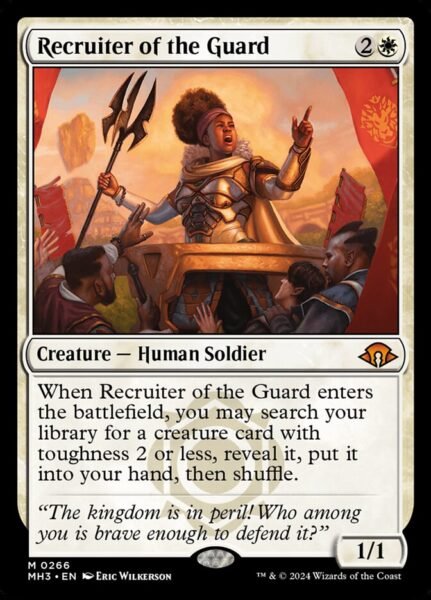
Recruiter of the Guard – searching for a creature with mana value 2 or less gives us a ton of options, including cards like Cloud, Midgar Mercenary that can get us another card.
Stoneforge Mystic – our one non-Human, we’re breaking our tribal theme for a bit of redundancy in searching for our Equipment, since they are one of our main ways of closing out a game.
Thraben Inspector – this unassuming common is more impactful than you may think. Sure, drawing a single card for won’t wow anyone, but with all of our Human synergies and blink effects, I expect this card to do a lot more. Furthermore, having this in our opening hand can let us keep some otherwise risky sevens.
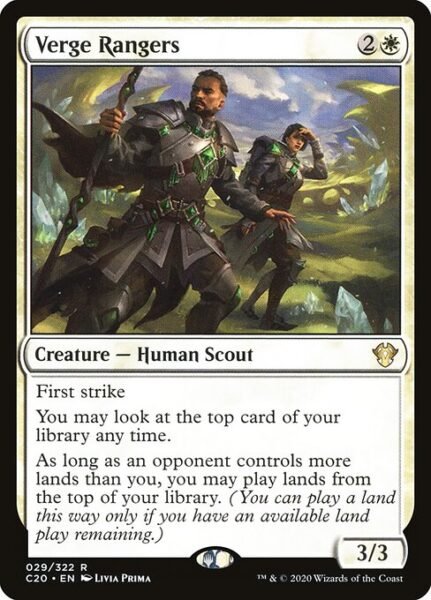
Verge Rangers – this kind of card always reads better on paper then it plays, but I still think the risk of this being just a 3-mana 3/3 with first strike is worth playing it. As an Aggro deck, we really don’t want to flood out and this Human Scout can help prevent this. Finally, we’re playing Terminus as a way to reset when behind on board and this card can let us know if we’re about to draw it.
Lord Effects
We have a few Humans who buff our team. These are those.
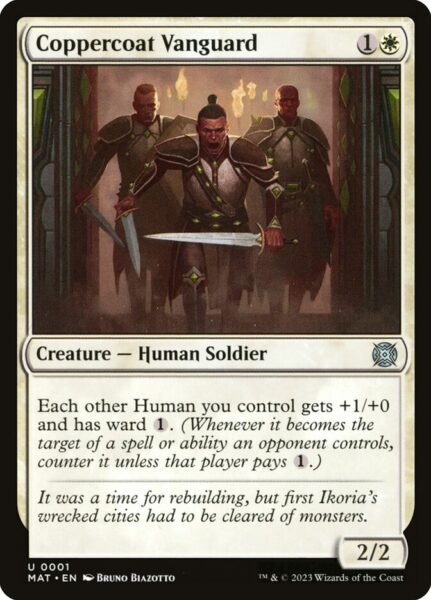
Coppercoat Vanguard – the +1/+0 is probably less impactful than the ward , honestly. Both are great in our deck, though.
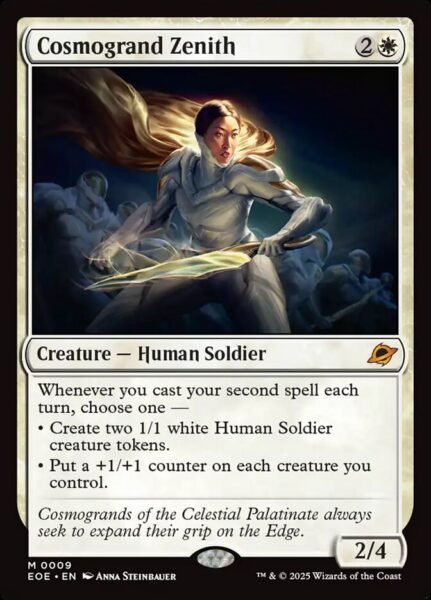
Cosmogrand Zenith – a powerful late-game card for us that can help rebuild, flood the board, or grow our team to lethal proportions.
Hero of Bladehold – we only get the +1/+0 on attacks, but still, this card is super powerful.
Thalia’s Lieutenant – a 1-time Lord effect for just the creatures on the battlefield, this 2-drop can be game-ending.
Humans Who Kill Things
Removal on the back of creatures can be risky, but the other synergies that come with them being Humans makes having some number of these worth it.
Banisher Priest – as an Aggro deck, we will often be reliant on tempo to win games. Building up a threatening board is important, but so is ensuring we can get through our opponent’s big bombs. Banisher Priest allows us to advance our board while taking out a blocker. And more often than not, our opponent won’t waste a kill spell on it, as we have more powerful, must-answer threats. A sweeper will give our opponent back their creature, but, at that point, Banisher Priest has done its job, one way or another.
Fiend Hunter – after reading and rereading these two cards next to each other, there is more of a difference than power and toughness. This Human Cleric allows us to exile any creature, including our own, not just an opponent’s. I’m not sure we’ll ever do this, but there may be a boardstate where doing so is the best play. For instance, let’s say our opponent needs a sweeper to stabilize or die. We can use this to exile one of our tutors so that when they wipe the board, we get both a body and either another creature or an Equipment.
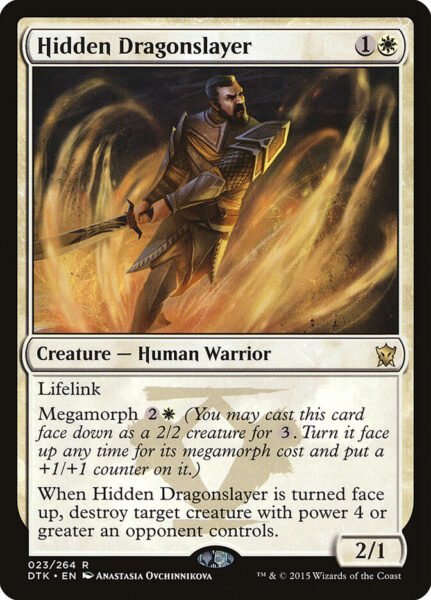
Hidden Dragonslayer – another thematic nod to my Mono Red Dragons deck, the first in this series, having another answer to a big creature attached to a body is good for us.
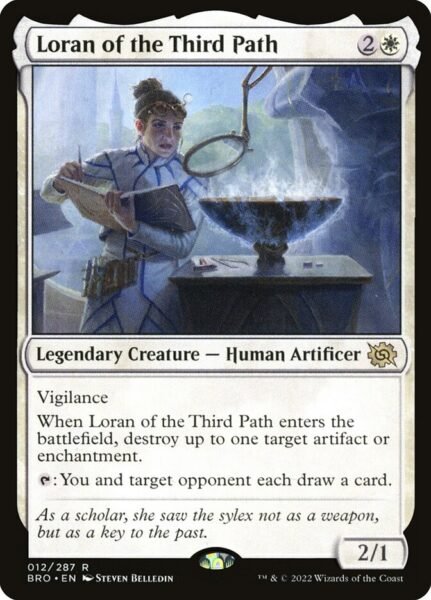
Loran of the Third Path – White has a number of creatures that have a similar effect as this in the 2-mana spot. I chose this 3-mana Human Artificer since it can destroy either an artifact or an enchantment. The card draw is gravy.
Humans Who Protect
This section has just the one entry, though there are several options, Mother of Runes being the most recognized. I play that card elsewhere, though.
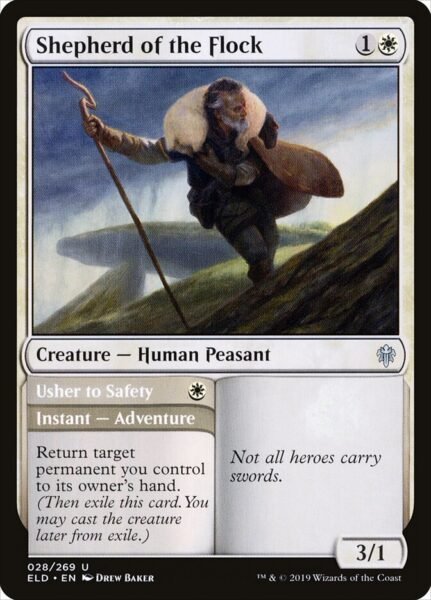
Shepherd of the Flock – I really like the 2-for-1 this card gives us, alongside the ability to bounce one of our creatures that tutors things up.
Prison Effects
We aren’t a Prison deck, but I still like having ways of slowing our opponents down, punching through damage, and protecting our team from instant-speed shenanigans.
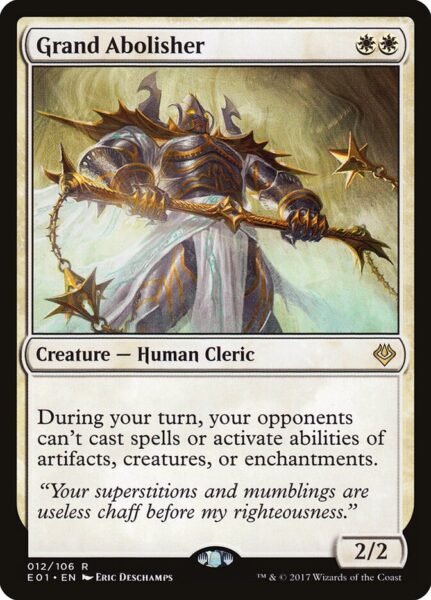
Grand Abolisher – forcing our opponent to play at sorcery speed does more than slow them down. It prevents surprise blowouts during combat, as well as shutting off counter magic.
Sanctifier en-Vec – shutting down a Reanimator or Storm deck is pretty sweet.
Thalia, Guardian of Thraben – forcing our opponents to pay more for their sweepers can be the difference in us winning and them stabilizing.
Thalia, Heretic Cathar – ditto that with opponents looking to stop the bleeding with blockers.
Voice of Victory – in most scenarios, this Human Bard will play as a strictly better Grand Abolisher.
Finish Them!!!
Even with a mana curve that ends in 4, we are playing some legitimate bombs that, if left unanswered, should win us the game. These are those.
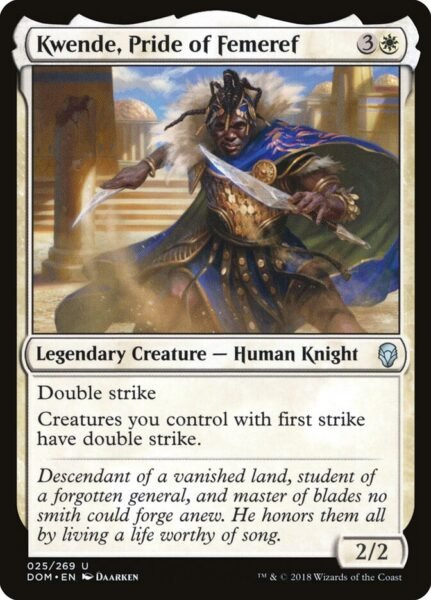
Kwende, Pride of Femeref – in conjunction with our commander, who can give all of our Humans first strike, this Human Knight hitting the battlefield should result in our victory the same turn, more often than not.
Odric, Master Tactician – nothing says victory like choosing all of your opponent’s blocks…
Riders of Gavony – our least reliable finisher since not every deck is a tribal one, we should still be able to use this card to get through some of our opponent’s best blockers.
Nonhuman Pieces
We aren’t just playing a bunch of Humans who do all the things. We have a variety of noncreature spells to support our game plan.
Anthem Effects
These kind of cards have come a long way since Glorious Anthem was first printed Urza’s Saga. What makes these cards so important is they are more likely to survive a sweeper, allowing us to rebuild faster after one.
Always Watching – vigilance may be redundant for us, but if we have this out before we resolve our commander, we’re in business!
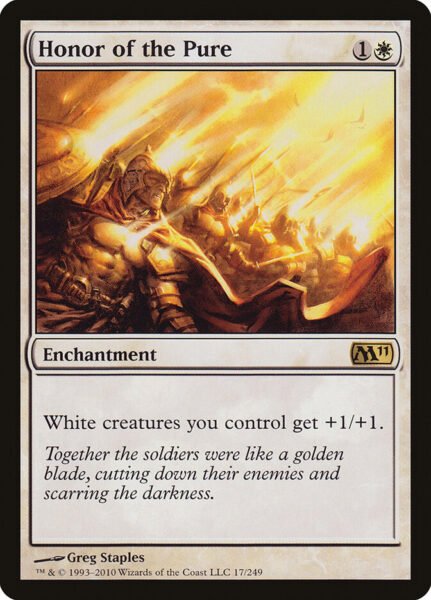
Honor of the Pure – not all of our creatures will get this buff, but the ones that don’t are fodder anyway.
Rally the Ranks – ditto for this one.
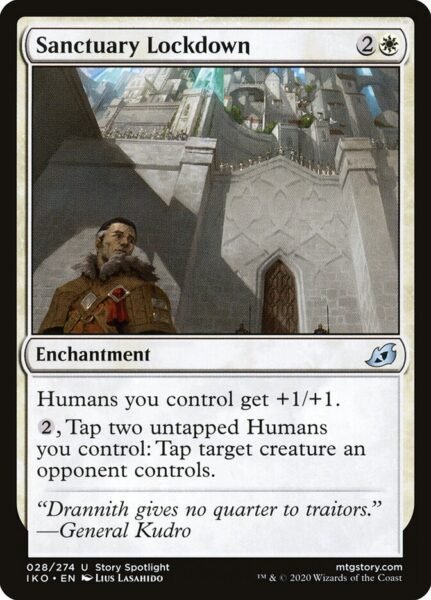
Sanctuary Lockdown – I love this card. It shores up two of our weaknesses. It makes our team more lethal and allows us to tap our opponent’s best creature before combat.
Spear of Heliod – a buff that can double as removal is also a powerful addition to our strategy.
Protection Spells
My first draft of this deck had a lot more ways to blink our creatures, but I had to make room for some Humans that brought some redundancy to the deck (Cloud, Midgar Mercenary, Coppercoat Vanguard) or shored up some weaknesses (Haliya, Guided by Light, Kwende, Pride of Femeref).
Akroma’s Will – this card is as much a finisher as a protection spell.
Cloudshift – thanks to Pauper, this card common costs more than $1.
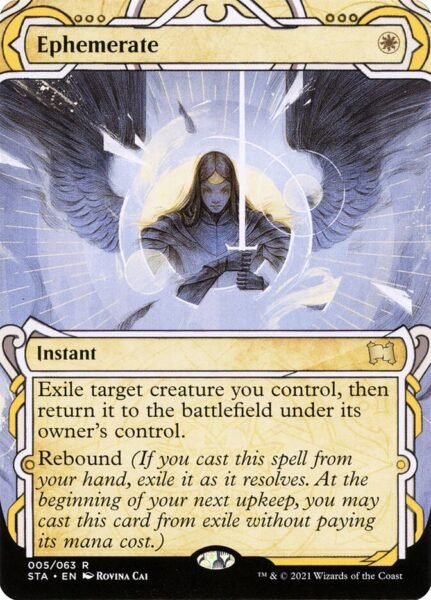
Ephemerate – while this one costs nearly $5!
Flawless Maneuver – free spells in Commander are annoying. But, if you can’t beat ’em…
Equipment
We may not be a Knight or Soldier deck, but having swords to equip to our Humans feels on-theme. These are some of our best ways to punch through damage, since several grant protection from certain colors.
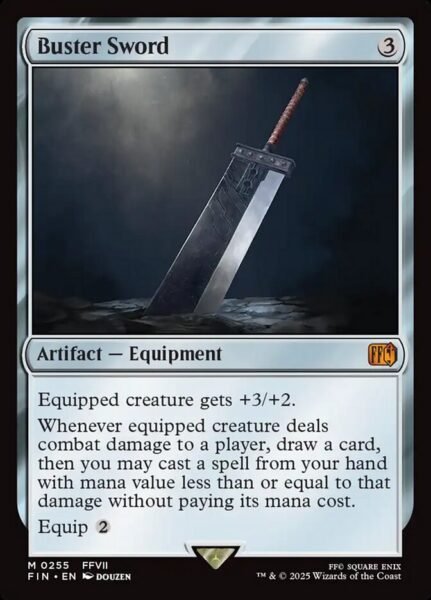
Buster Sword – I don’t know anything about Final Fantasy, but I opened up a foil copy of this mythic and it’s been sitting in my binder until now. The funny thing is that, despite its obvious power, I don’t think we’re the best deck for it. After all, we have a very low mana curve, which means both casting something for free won’t save us that much mana and there’s a good chance we’ll either be empty handed or unwilling to commit more to the board by the time this card hits the battlefield and gets equipped.
Sword of Feast and Famine – ditto this one on the whole untapping all of our lands clause. Pro Black and Green is our main focus here.
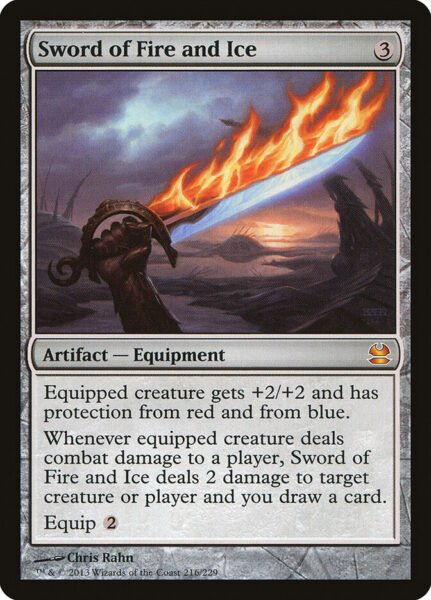
Sword of Fire and Ice – card draw is great. The damage can make blocking difficult for our opponent.
Sword of Hearth and Home – pro Green and White means we have all five colors covered now. Unlike the other three swords so far, this one is super powerful in our deck. Blinking a creature with an enters ability is busted for us. The land is pretty nice, too.
Sword of the Animist – our least exciting Equipment, thinning our deck is nice.
Removal
We need a critical mass of Humans to execute our game plan, but cheap removal and sweepers are both necessary in their own way. The former can help with our aggressive starts by taking out our opponent’s best (or only) blocker. The latter is a necessary evil in games when our opponents have stabilized and turned the corner on us. We can sandbag some creatures, wipe the board, then hope to get through the last bit of damage with what we’ve been holding.
A quick general observation about my choices. I’ve put a primacy on removal that doesn’t say “destroy.” My playgroup has begun running more and more protection spells that give indestructible. Exile, or in the case of two of my sweepers, “put all creatures on the bottom of their owners’ library,” gets around this. The targeted exile removal still gets hosed by hexproof, but we can’t have it all, alas.
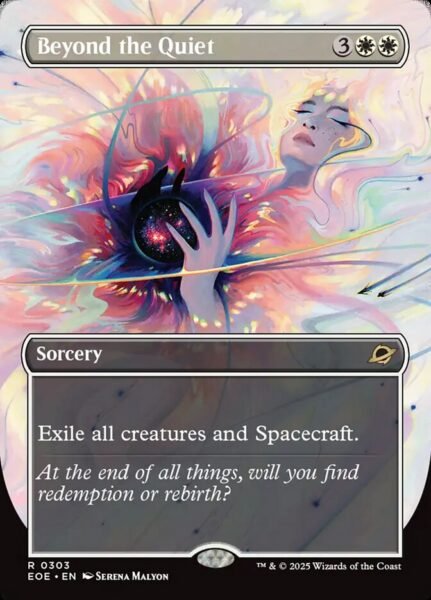
Beyond the Quiet – you never know when you’ll run into that one person playing a Spacecraft deck!
Declaration in Stone – I like this card mostly as a clean answer to token strategies.
Hallowed Burial – oh, you wanted to use your graveyard? Ha!
Path to Exile – we can use this to ramp ourselves, too.
Swords to Plowshares – the OG and still the best.
Terminus – doubt our opponents will see this one coming.
Card Draw
Most of our card draw and tutors are attached to creatures. Still, we have a few noncreature ways to gain card advantage.
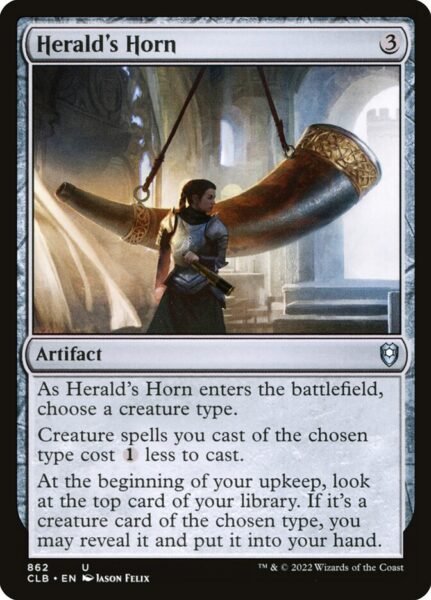
Herald’s Horn – with 35 Humans in our deck, we have a 1-in-3 chance of getting a card off the top of our library.
Sword of Fire and Ice – there’s a reason these swords are so expensive. Protection, buff, card advantage, and damage. That’s a lot.
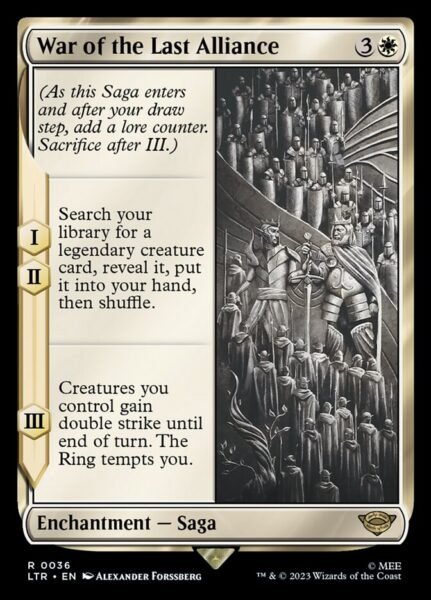
War of the Last Alliance – we play nine legendary creatures we can get with the first two chapters of this saga and one that will go get us an equipment (Cloud, Midgar Mercenary). I really like this card and think its sneaky powerful and woefully underrated/underplayed (about 1% of decks run it). Its third chapter is a legitimate way for us to close out a game.
Ramp
We are pretty light on ramp compared to most decks. With a curve ending in four, I think we can get away with this. If I had an extra copy of Oketra’s Monument, I’d make room for it, even though the tokens we get off of it are not Humans.
Herald’s Horn – this card can do some work for us.
Pearl Medallion – ditto this one.
Sword of Hearth and Home – by the time we’re hitting with a creature with this sword attached, the lands we’re getting will be less ramp and more deck thinning. Still, our commander is likely to die at least once, so we do want to get to six mana eventually.
Sword of the Animist – this card will start ramping us on turn 3. Not too shabby.
The Rest
There aren’t many more cards to write about. I don’t usually go into such detail about removal and ramp, but since this article is meant to help a new player learn how to play, I took the time to write about them.
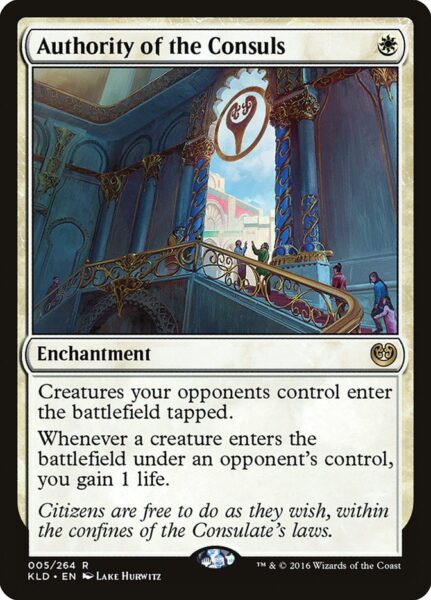
Authority of the Consuls – lifegain is great and all, but we really care about the first line of text. Opponents hoping to stop the bleeding with blockers will have to take their beats an extra turn. Sometimes, that’s all it takes.
Cathars’ Crusade – one of our bombs, if we untap with this enchantment out and any kind of boardstate, we’ll be in business.
Flex Spots
With over 1,200 mono White Humans to choose from, you could build several totally unique Human Tribal decks. Decisions have to be made, though, and I was guided by a number of criteria. First, while our commander is a Human Soldier, this is not a Soldier Tribal deck. Thus, cards that synergize with Soldiers were left out.
Second, I play a lot of decks that care about lifegain and counters. We certainly can’t avoid lifegain with our commander, but I can avoid the kind of lifegain synergies I play elsewhere. As to counters, I also left cards out that care about these.
Finally, there are quite a few Humans who tax our opponent in a variety of ways (Thalia, Guardian of Thraben, for example). And while I am playing a few of these as support pieces, I already have a Mono White Taxes deck that runs a bunch of hate bears. I’ve left most of them out of this deck.
All that being said, here are some of the cards that I could see another person making room for. Many of these could easily be swapped in for some of my meta-based choices (Dragon Hunter, for example).
Airlift Chaplain .20 cents
Ambitious Farmhand .25 cents
Anointed Peacekeeper .38 cents
Auriok Windwalker .59 cents
Boromir, Warden of the Tower $6.17
Court Street Denizen .20 cents
Defiler of Faith .49 cents
Devout Chaplain .29 cents
Elite Spellbinder .35 cents
Giant Killer .40 cents
Guardian of New Benalia .35 cents
Haazda Marshal .28 cents
Honored Knight-Captain .24 cents
Hopeful Initiate .35 cents
Imposing Sovereign .46 cents
Jet, Rebel Leader .33 cents
Kytheon, Hero of Akros $1.57
Lossarnach Captain .44 cents
Luminarch Aspirant .50 cents
Moorland Rescuer .40 cents
Mother of Runes $11
Mystic Crusader .50 cents
Nykthos Paragon .75 cents
Puresteel Paladin .80 cents
Recruitment Officer .25 cents
Reluctant Role Model .40 cents
Reverent Hoplite .30 cents
Serra Ascendant $32
Sigrid, God-Favored .39 cents
Sokka, Swordmaster $1.43
Spellbook Vendor .60 cents
Stalwart Pathlighter .37 cents
Tax Collector .30 cents
The Duke, Rebel Sentry .25 cents
The Wandering Rescuer $2.44
Tithe Taker .40 cents
Trynn, Champion of Freedom $1.37
Victory’s Envoy .40 cents
War Priest of Thune .24 cents
Weapons Vendor .22 cents
Witch Enchanter $3.71
Ideal Hand and Game Play
Unlike many of the decks I write about, we are fine with 2-land hands, assuming we have the low end of our curve as the rest of our cards. A hand full of 1- and 2-drops, two lands, and maybe a mana rock or removal spell is a great hand for us. We’ll have time to find both lands and action while we pressure our opponent. Any of our anthem effects are also ideal.
In a hand with three lands, we can keep it if we still have 1- and 2-drops to play, followed by one of our better 3-drops. Four lands and we should probably mulligan unless the other three cards line up very well with our opponent’s strategy or we have multiple tutors.
From there, we want to commit creatures to the board until we can resolve our commander and immediately turn on the +2/+2 clause. This is our fastest route to victory. Once done, we need to be more cautious with what we play so as not to overcommit and get blown out by a sweeper. This is where our anthem effects, spot removal, and tutors come in. Any of these can be played with little concern for a sweeper.
Turns 1-4 should be fairly straightforward. We play creatures and attack. However, once our opponent starts putting down legitimate blockers and threats, things get complicated. Despite being an Aggro deck, it is important to know when to put on the brakes, pass the turn, and wait. Sometimes we’re waiting for a sweeper or baiting our opponent into one. Sometimes we’re waiting for more anthem effects or more creatures. But we will often be forced to stop our aggression long enough to set up for one big attack that either kills our opponent or leads to trades in combat that favor us to such an extent that we will kill them the next turn.
This balance of attacking and waiting is one aspect of every Aggro deck and takes time and experience to master. One more piece of advice is this: in a situation where your opponent can block and both creatures die, put yourself in their shoes and try to see how important that creature is to their strategy. If you can assess it as important, swing away. Most of our creatures are here to do just that. If their creature has done its work (has an enters effect, for instance), then be more cautious as they will likely make the trade.
Finally, the swords that grant protection are important in breaking through stalled boards. Be aware of this and take your time resolving one if you’re worried about counters or artifact removal. For budget players, your equipment won’t grant protection, but you still want it to resolve, since it sits on the battlefield through most sweepers and will help you get a fast clock again.
Weaknesses
As a low-to-the-ground Aggro deck, we have a few big weaknesses. First, running out of gas, either because of mana flood or sweepers. Even playing with the latter in mind won’t always mean our hand will be flush with threats after our opponent wipes the board.
Second, our late-game draws are as likely to be underwhelming as not. We are playing only a few cards that can be considered bombs in the traditional sense and most of these are only bombs when we have creatures on the battlefield. Drawing a Soldier of the Pantheon on turn 8 is brutal when our opponent is drawing a 6- or 7-drop. To help with this, play noncreature spells that give you value along the way. Taking a turn off to cast Spear of Heliod over Adeline, Resplendent Cathar can help keep our hand full of threats, while still advancing our board and pressuring our opponent’s life total with our 1- and 2-drops.
Similarly, using a blink spell to gain card advantage will often be more advantageous in the mid-game than playing more creatures.
Finally, we only have a handful of ways to give our team evasion and are playing a total of 0 fliers. Bird Tribal and decks full of flying creatures can give us issues. Decks that can clog up the board on the ground can, as well. This is where our lifegain and protection comes in. The former can help us win the race, while the latter will help punch through damage.
Conclusion
If you’re looking to build an easy-to-play deck that you can give to a friend just learning the game, then give Mono White Humans with Greymond, Avacyn’s Stalwart a shot! It will do a great job teaching a new player the power of synergy, the nuances of combat, and the importance of tempo. For more experienced players, it also happens to be a lot of fun!
Thanks for reading and watching! Do you have a go-to deck you break out to teach new players? If so, what is it?